



Introducing Behavioural Modelling


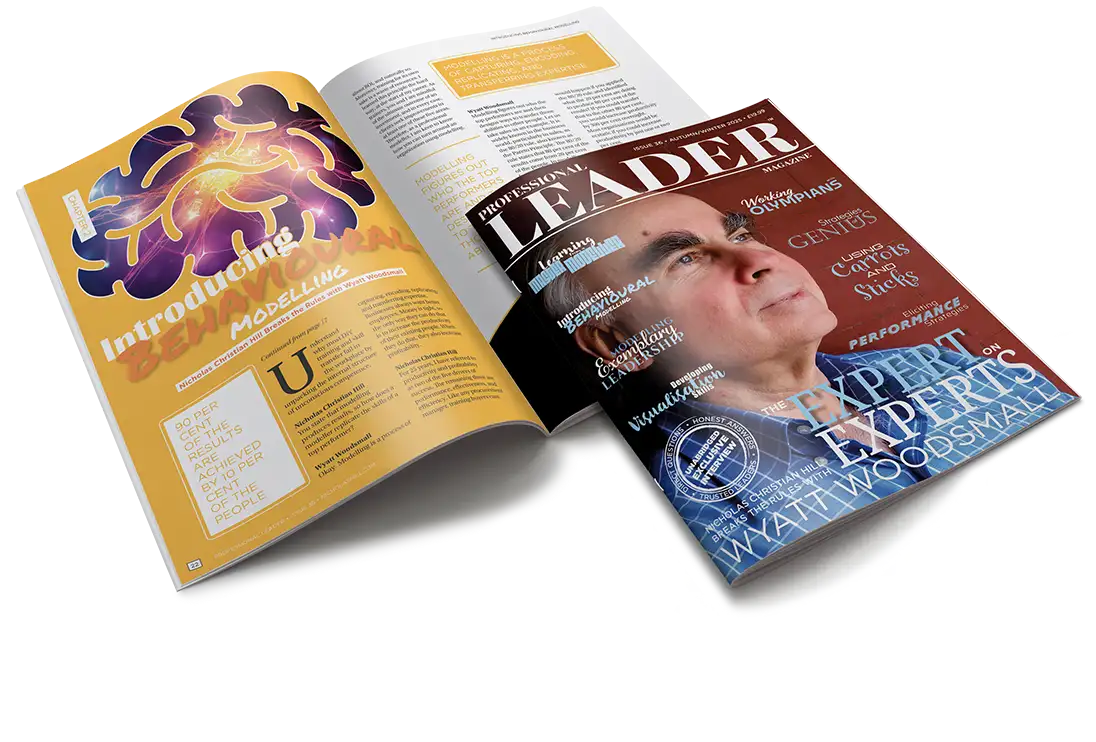






































































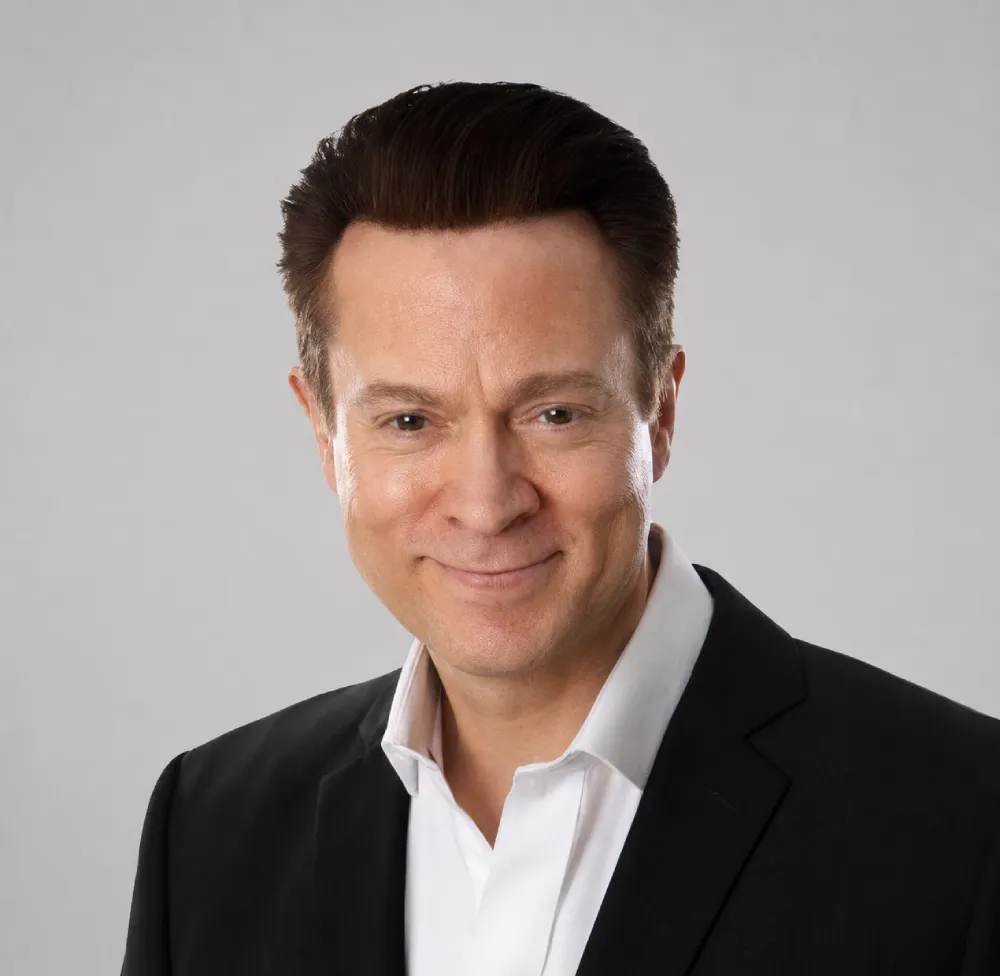
Nicholas Christian Hill
Nicholas Christian Hill FCMI FIoL FIC Managing Director, Nicholas Hill Academy Ltd Leadership and Management Master Trainer Founding Editor, Professional Leader Magazine
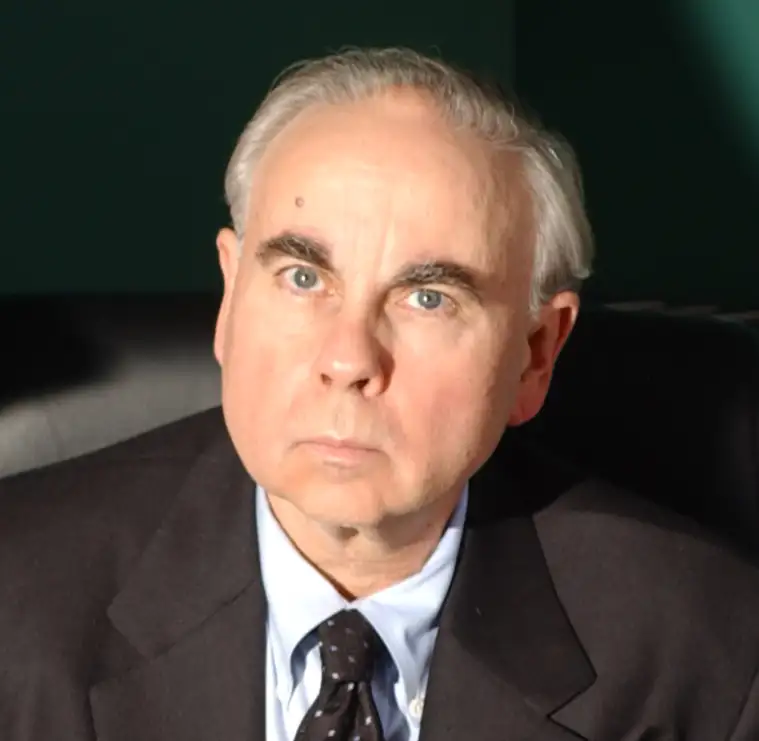
Dr Wyatt Woodsmall
Certified Master Modeller Co-Creator, Advanced Behavioural Modelling Co-Founder, International NLP Trainers Association Co-Author, Time Line Therapy and the Basis of Personality

Nicholas Christian Hill
You state that modelling produces results, so how does a modeller replicate the skills of a top performer?
Wyatt Woodsmall
Okay. Modelling is a process of capturing, encoding, replicating, and transferring expertise. Businesses always want better employees. Money is tight, so the only way they can do that is to increase the productivity of their existing people. When they do that, they also increase profitability.
Nicholas Christian Hill
For 25 years, I have referred to productivity and profitability as two of the five drivers of success. The remaining three are performance, effectiveness, and efficiency. Like any procurement manager, training buyers care about ROI, and naturally so. Moreover, training for its own sake is a waste of resources. I learned this principle the hard way, at the start of my career. As trainers, you and I are mindful of the ultimate outcome of an investment, and in every case, clients seek improvements in at least one of these five areas. Therefore, as a professional modeller, I am keen to know how you can turn around an organisation using modelling.
Wyatt Woodsmall
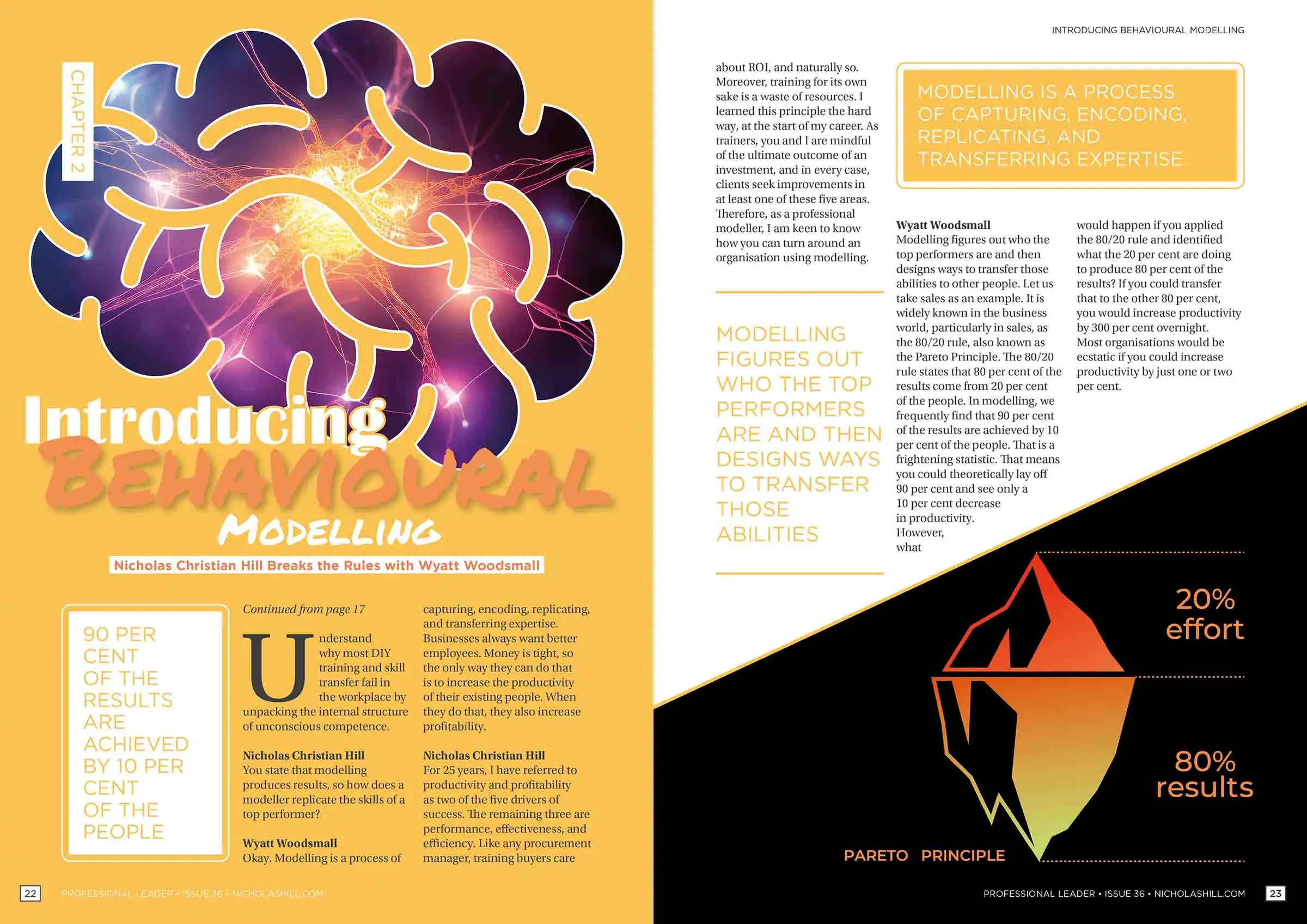
Modelling figures out who the top performers are and then designs ways to transfer those abilities to other people. Let us take sales as an example. It is widely known in the business world, particularly in sales, as the 80/20 rule, also known as the Pareto Principle. The 80/20 rule states that 80 per cent of the results come from 20 per cent of the people. In modelling, we frequently find that 90 per cent of the results are achieved by 10 per cent of the people. That is a frightening statistic. That means you could theoretically lay off 90 per cent and see only a 10 per cent decrease in productivity. However, what would happen if you applied the 80/20 rule and identified what the 20 per cent are doing to produce 80 per cent of the results? If you could transfer that to the other 80 per cent, you would increase productivity by 300 per cent overnight. Most organisations would be ecstatic if you could increase productivity by just one or two per cent.
Nicholas Christian Hill
I agree. Some managers view leadership and management development as abstract and theoretical. At the beginning of my career, I used to be defensive about many of these models. Today, I welcome debate in my courses because it is an opportunity for me to learn and grow. This is why my training style has evolved into a strategic group facilitation approach over the years, in which we adapt many of the models to enhance practicality. Research in organisational psychology indicates that leadership success is more closely linked to behavioural change and decision-making in real-world scenarios than to formal education. However, education remains the very foundation on which we leaders stand. So, I am curious, Wyatt. How do we make behavioural modelling more than just an academic exercise?
Wyatt Woodsmall
Most training is based on someone’s theory of what works. Modelling training is based on what successful people in that organisation are actually doing. Modelling is a way to make training much more productive and profitable. Training is expensive because you not only have to pay for it, but you also lose productivity while people are undergoing training. So modelling is the front end of what successful people actually do: transferring those capabilities rather than relying on someone’s theory about what works, which is usually only partially correct.
Nicholas Christian Hill
Okay. As we have discussed, a modeller is only concerned with an organisation’s top performers, and, from your experience, those top performers account for about 10 per cent of the workforce. As a student of yours, I already support modelling; however, I would like to play devil’s advocate as a voice for our readers. What if you just took the top 10 per cent and had them teach the other 90 per cent what they are doing, as many organisations instinctively attempt to do? Would they be able to do that?
Wyatt Woodsmall
No, they would not, for this reason: people operate out of unconscious competence. Experts do not know how they do what they do. The proof is simple: if they knew what they were doing and could transfer those abilities, the people they train would be as good as they are. However, that is rarely the case.
Nicholas Christian Hill
I agree and would like to expand on this point, if I may. Whenever somebody develops a skill set, they go through four separate developmental stages, defined as 1) unconscious incompetence, 2) conscious incompetence, 3) conscious competence, and then 4) unconscious competence. As you state, successful people operate out of stage four. Indeed, experts will operate beyond stage four. For instance, author Joseph O’Connor posits a stage five: mastery. Please explain how you elicit the structure of unconscious competence.
Wyatt Woodsmall
Absolutely. Modelling unpacks unconscious competence. The best compliment that we are given after a modelling project is to be told, ‘You have a far better understanding of how I do what I do than I do.’ When Marilyne and I worked with the US Olympic Team, the divers said, ‘The US diving team has been bringing people in, particularly psychologists, for years to talk to us, and you are the first people that actually understand what we do, speak our language, and can give a better explanation of what we do than we can ourselves.’ It is not effective to expect the top 10 per cent to train the others, because they do not know how they do what they do.
Nicholas Christian Hill
To better understand this discipline, we need to break down the components of modelling. What you are describing runs counter to how most organisations still approach learning. There is a long-held assumption that expertise can simply be explained, documented, and handed over, but decades of skill-development research suggest otherwise. The Dreyfus model, for example, shows that experts rely primarily on pattern recognition rather than on conscious rule-following. That makes them impressive performers, but often poor teachers of their own craft. When leaders ask their top performers to mentor others, they are frequently disappointed with the results. Frankly, I am not overly concerned because it keeps me in a job! What I want to explore with you is strategy elicitation, which involves uncovering the unconscious cognitive and behavioural strategies that are invisible to the performer and turning them into a structure that others can learn. With that objective in mind, how would you break down the components of modelling?
Wyatt Woodsmall
Sure. As we have discussed, modelling is a process of capturing, encoding, replicating, and transferring expertise. This transfer is a key part of the process. I have spent 30 years modelling training delivery. In general, most training out there is lousy. We have some powerful models, as you know, because you learned some of them in your trainers’ training with me. People who are content experts do not necessarily know anything at all about training. Therefore, we combine expertise in eliciting unconscious competence, designing a training programme, and delivering it to transfer expertise. In short, that is why experts cannot transfer their abilities directly to others.