



Presenting Science or Pseudoscience









































































Nicholas Christian Hill
Nicholas Christian Hill FCMI FIoL FIC Managing Director, Nicholas Hill Academy Ltd Leadership and Management Master Trainer Founding Editor, Professional Leader Magazine
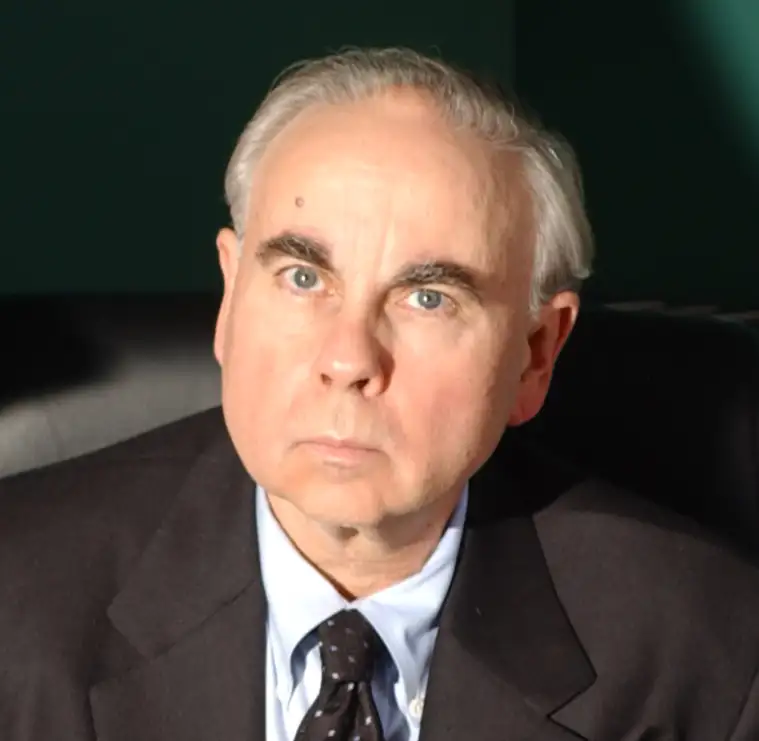
Dr Wyatt Woodsmall
Certified Master Modeller Co-Creator, Advanced Behavioural Modelling Co-Founder, International NLP Trainers Association Co-Author, Time Line Therapy and the Basis of Personality


Nicholas Christian Hill
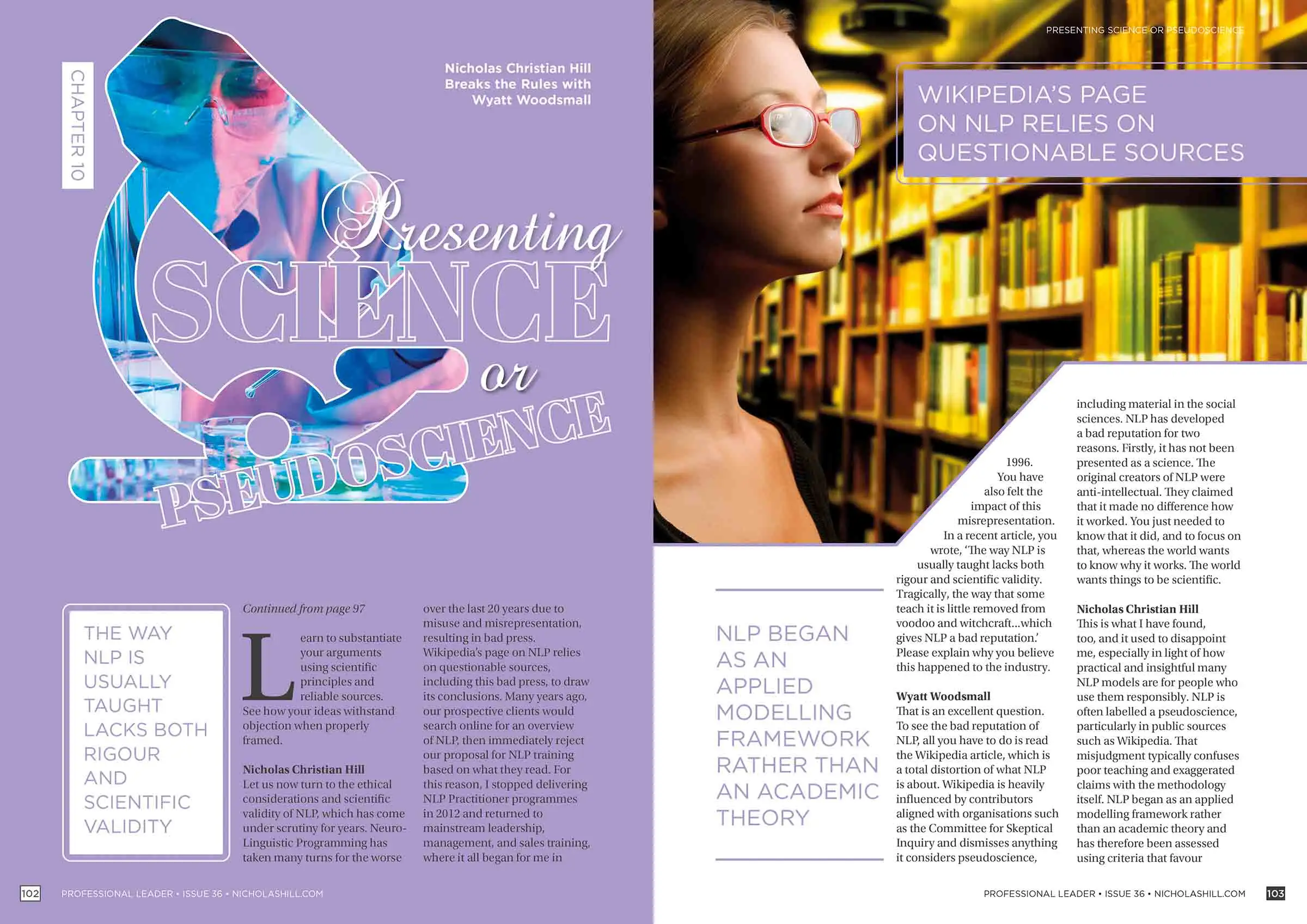
Let us now turn to the ethical considerations and scientific validity of NLP, which has come under scrutiny for years. Neuro-Linguistic Programming has taken many turns for the worse over the last 20 years due to misuse and misrepresentation, resulting in bad press. Wikipedia’s page on NLP relies on questionable sources, including this bad press, to draw its conclusions. Many years ago, our prospective clients would search online for an overview of NLP, then immediately reject our proposal for NLP training based on what they read. For this reason, I stopped delivering NLP Practitioner programmes in 2012 and returned to mainstream leadership, management, and sales training, where it all began for me in 1996. You have also felt the impact of this misrepresentation. In a recent article, you wrote, ‘The way NLP is usually taught lacks both rigour and scientific validity. Tragically, the way that some teach it is little removed from voodoo and witchcraft...which gives NLP a bad reputation.’ Please explain why you believe this happened to the industry.
Wyatt Woodsmall
That is an excellent question. To see the bad reputation of NLP, all you have to do is read the Wikipedia article, which is a total distortion of what NLP is about. Wikipedia is heavily influenced by contributors aligned with organisations such as the Committee for Skeptical Inquiry and dismisses anything it considers pseudoscience, including material in the social sciences. NLP has developed a bad reputation for two reasons. Firstly, it has not been presented as a science. The original creators of NLP were anti-intellectual. They claimed that it made no difference how it worked. You just needed to know that it did, and to focus on that, whereas the world wants to know why it works. The world wants things to be scientific.
Nicholas Christian Hill
This is what I have found, too, and it used to disappoint me, especially in light of how practical and insightful many NLP models are for people who use them responsibly. NLP is often labelled a pseudoscience, particularly in public sources such as Wikipedia. That misjudgment typically confuses poor teaching and exaggerated claims with the methodology itself. NLP began as an applied modelling framework rather than an academic theory and has therefore been assessed using criteria that favour laboratory testing over results. Ironically, many of its core ideas now align with established research in neuroscience and cognitive psychology. The issue is the failure to present NLP in a scientific context, which has allowed critics to discredit it unfairly. While the industry has suffered long-term reputational damage, how do you suppose we learn from this experience?
Wyatt Woodsmall
In your trainer’s training, we discussed the 4MAT Model. In the ‘what’ quadrant, we talked about the importance of sharing the concept, principles, process, and procedure. The concepts and principles explain why it works and why it is scientific. NLP has a bad reputation because much of the unofficial material is New Age thinking, has all sorts of Green aphorisms, and is not based on any science. However, NLP research is grounded in science, yet many people are unaware of this and do not present it as such. So, the world looks at it and says, ‘This is not something we are interested in. This is not scientific.’
Nicholas Christian Hill
We trainers and expert teachers alike use the 4MAT Model, developed by Dr Bernice McCarthy, to guide learners through a four-part cycle, each represented by quadrants or ‘mats’, hence the name. Quadrant 1, covered earlier, is the ‘why’. Quadrant 2 is the ‘what’. Quadrant 3 is the ‘how’. Finally, quadrant 4 is the ‘what-if’. Suppose a manager is teaching or training their team. Before turning attention to the ‘how,’ they must take their audience through the ‘what’. If they fail to substantiate their argument with evidence and scientific principles, their team could be sceptical of any proposal. Wyatt, please share your findings on scientific validity, as you deliver trainers’ training around the globe.
Wyatt Woodsmall
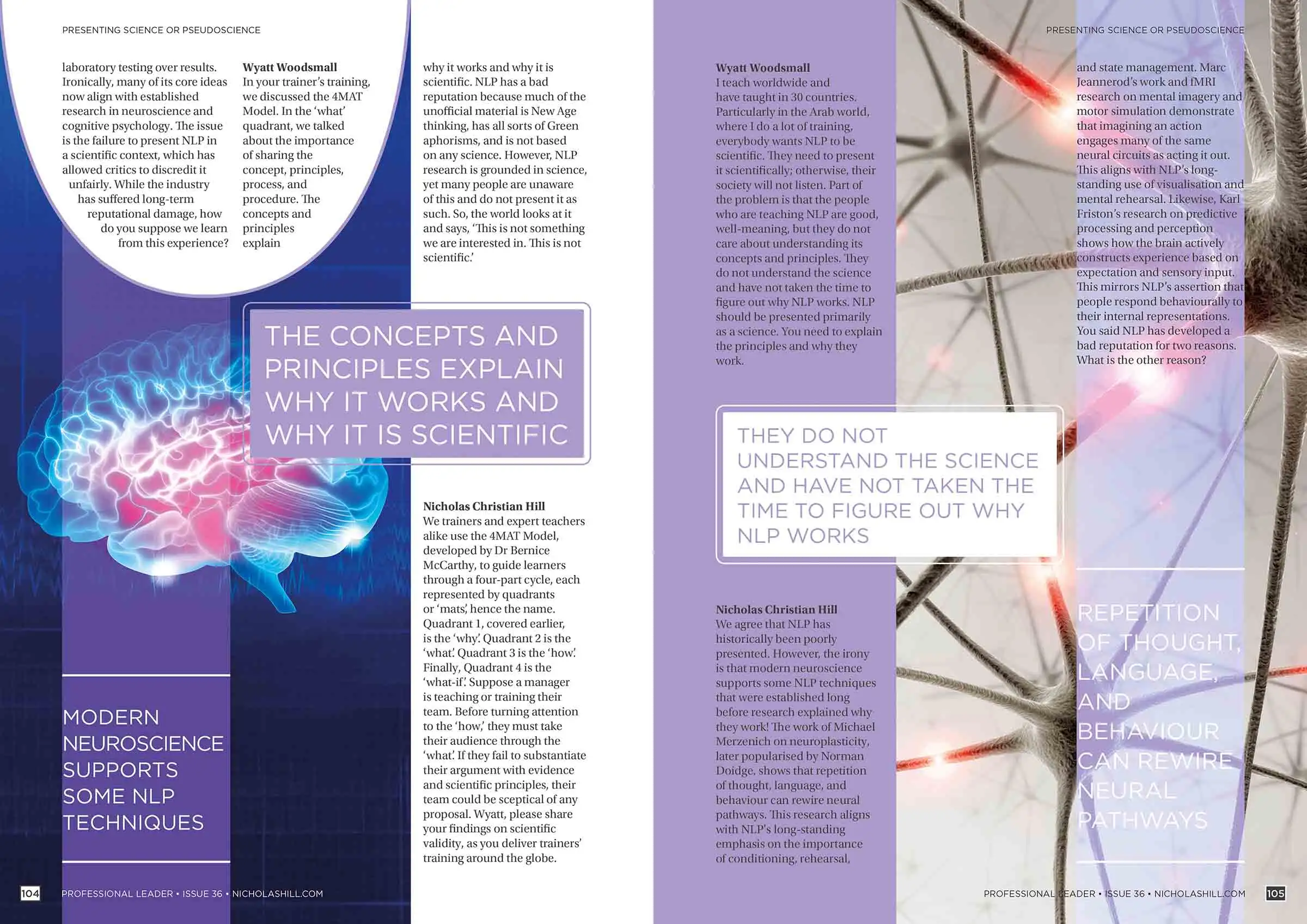
I teach worldwide and have taught in 30 countries. Particularly in the Arab world, where I do a lot of training, everybody wants NLP to be scientific. They need to present it scientifically; otherwise, their society will not listen. Part of the problem is that the people who are teaching NLP are good, well-meaning, but they do not care about understanding its concepts and principles. They do not understand the science and have not taken the time to figure out why NLP works. NLP should be presented primarily as a science. You need to explain the principles and why they work.
Nicholas Christian Hill
We agree that NLP has historically been poorly presented. However, the irony is that modern neuroscience supports some NLP techniques that were established long before research explained why they work! The work of Michael Merzenich on neuroplasticity, later popularised by Norman Doidge, shows that repetition of thought, language, and behaviour can rewire neural pathways. This research aligns with NLP's long-standing emphasis on the importance of conditioning, rehearsal, and state management. Marc Jeannerod’s work and fMRI research on mental imagery and motor simulation demonstrate that imagining an action engages many of the same neural circuits as acting it out. This aligns with NLP’s long-standing use of visualisation and mental rehearsal. Likewise, Karl Friston’s research on predictive processing and perception shows how the brain actively constructs experience based on expectation and sensory input. This mirrors NLP’s assertion that people respond behaviourally to their internal representations. You said NLP has developed a bad reputation for two reasons. What is the other reason?
Wyatt Woodsmall
The second reason is that NLP has been accused of being unethical. And there is a reason. One well-formed condition for outcomes is that they must be ecological. Ecology is the study of consequences and the tracing of their effects through a system. However, ecology applies to systems; it applies to the outside of the collective. It does not apply to the inside of the individual, or to the inside of the collective. The inside of the collective is ethics. Ethics and ecology are two different concepts. One of the things I have done in my trainings is modify the well-formed conditions for outcomes to ensure they are both ethical and ecological. Ethics depends on the culture in which you operate. NLP, because it has ignored ethics and focused solely on ecology, has led people to say, ‘Well, you are unethical.’ People need to understand that they must focus on both, and the outcome conditions must be amended to ensure outcomes are both ethical and ecological. These are two primary reasons NLP is in a bad situation.
Nicholas Christian Hill
I recall you describing ethics and ecology in this same way years ago. Following my work with you, I continue to communicate to my clients the importance of both. To reinforce understanding, I use metaphors frequently in training. The metaphor I use for ethics and ecology might go something like this: imagine you are standing by a lake. You can see a mirrored reflection of all the surrounding landscape. Not a creature stirs under the water. You pick up a rock, and with a flick of your wrist, you skim it across the lake, creating ripples that eventually reach the other side. Now, let’s break down the metaphor. Your internal state and processes that motivated your actions are subject to ethical scrutiny, so you would need to ask yourself questions like ‘Why did I want to do that?’ or ‘What was the trigger that initiated my behaviour?’ On the other hand, the effect on the external environment would determine the ecology. Here, you would need to ask questions like, ‘How did my actions affect the lives of creatures in the lake and outside the lake?’ The metaphor then becomes a catalyst for discussing ethics and ecology in leadership. At that time, we get a shift of context.
Wyatt Woodsmall
That’s a good metaphor, Nicholas. One thing we need to understand is that ethics concerns the inner workings of the collective. You do not have ethics in isolation. Ethics is part of culture. It is not just what you think and believe. It is what people in the culture you operate in think and believe. It’s what they consider appropriate or inappropriate behaviour. What you think is always going to be shaped and influenced by the culture in which you are operating.
Nicholas Christian Hill
That is an excellent point. The metaphor I just shared presupposes that the person standing by the lake holds beliefs and values shaped by their culture, and that these are not arbitrary or self-initiated. It depends on which box you are standing in. You might be standing in the context of your home, your work, your community, your church, your synagogue, and so forth.
Wyatt Woodsmall
Correct. And you may be standing in multiple boxes!