



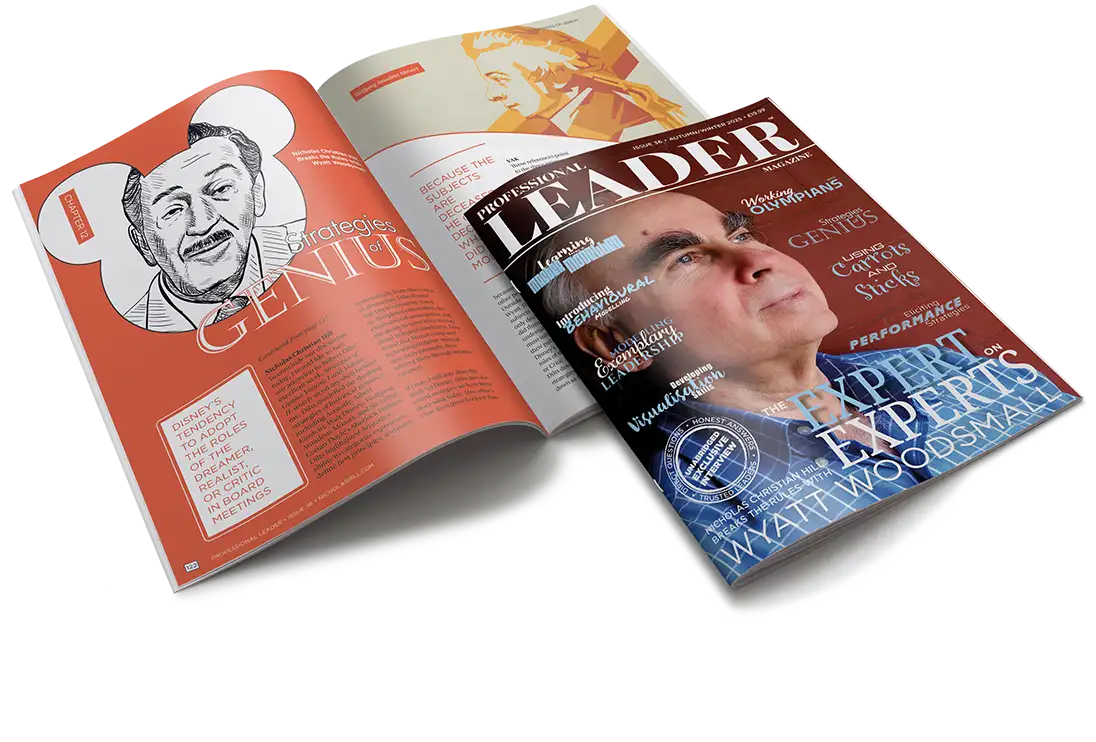
Strategies of Genius






































































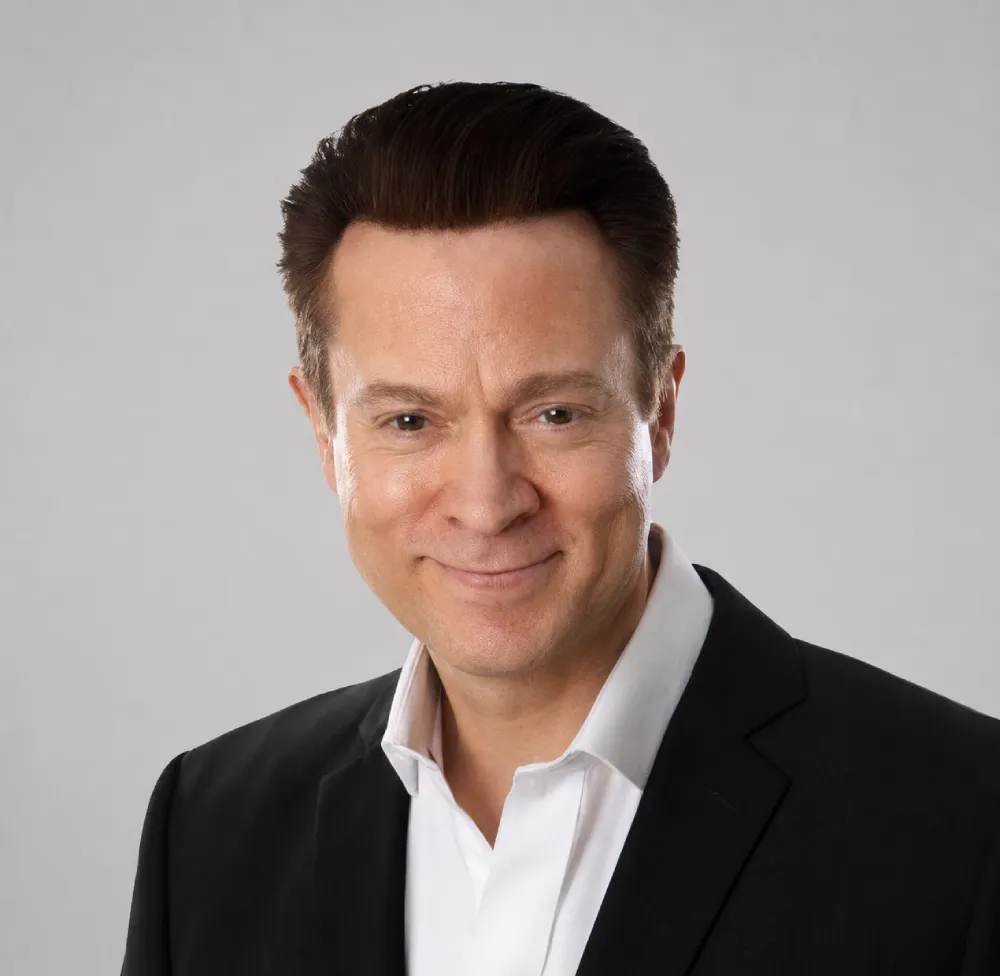
Nicholas Christian Hill
Nicholas Christian Hill FCMI FIoL FIC Managing Director, Nicholas Hill Academy Ltd Leadership and Management Master Trainer Founding Editor, Professional Leader Magazine

Dr Wyatt Woodsmall
Certified Master Modeller Co-Creator, Advanced Behavioural Modelling Co-Founder, International NLP Trainers Association Co-Author, Time Line Therapy and the Basis of Personality

Nicholas Christian Hill
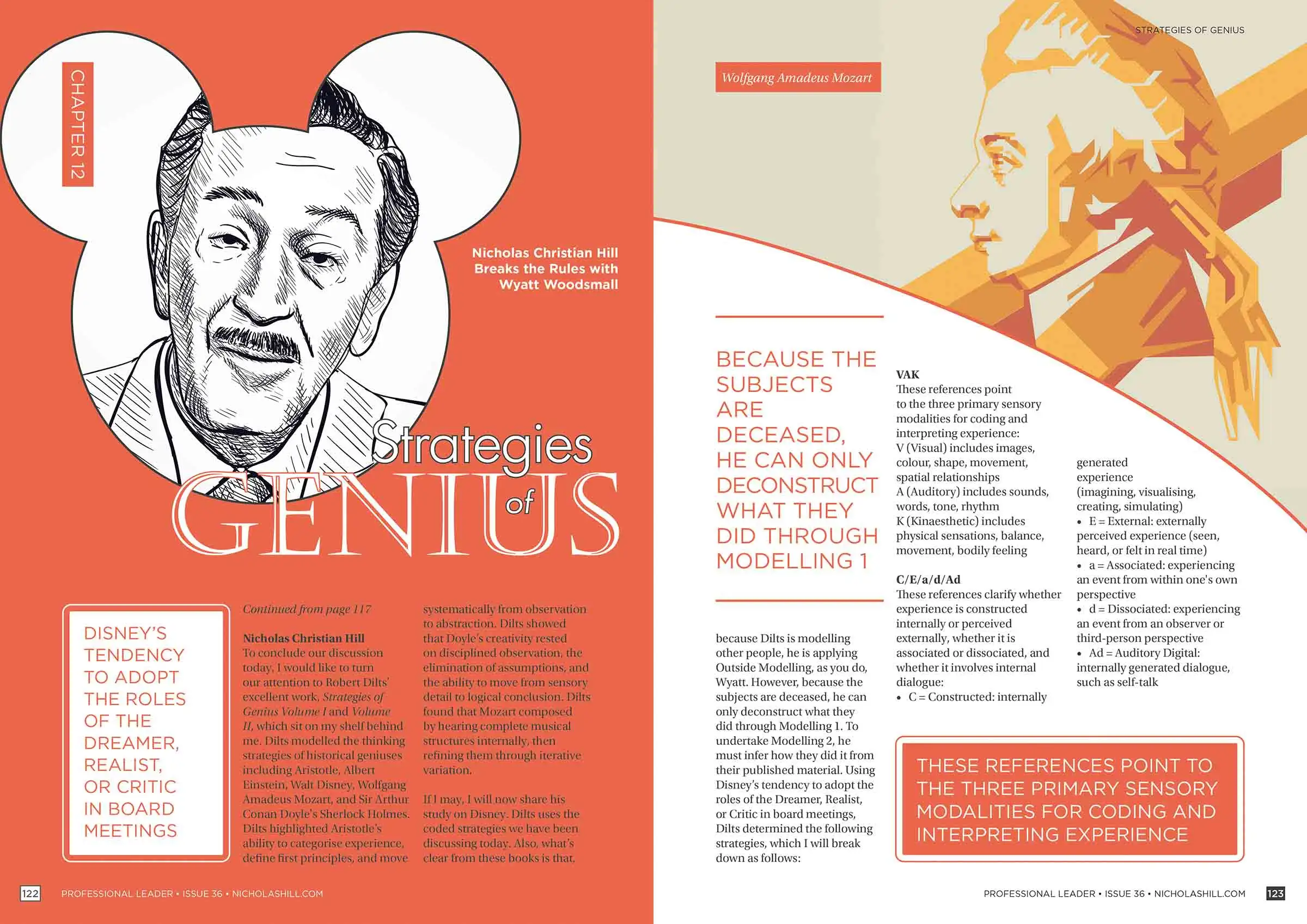
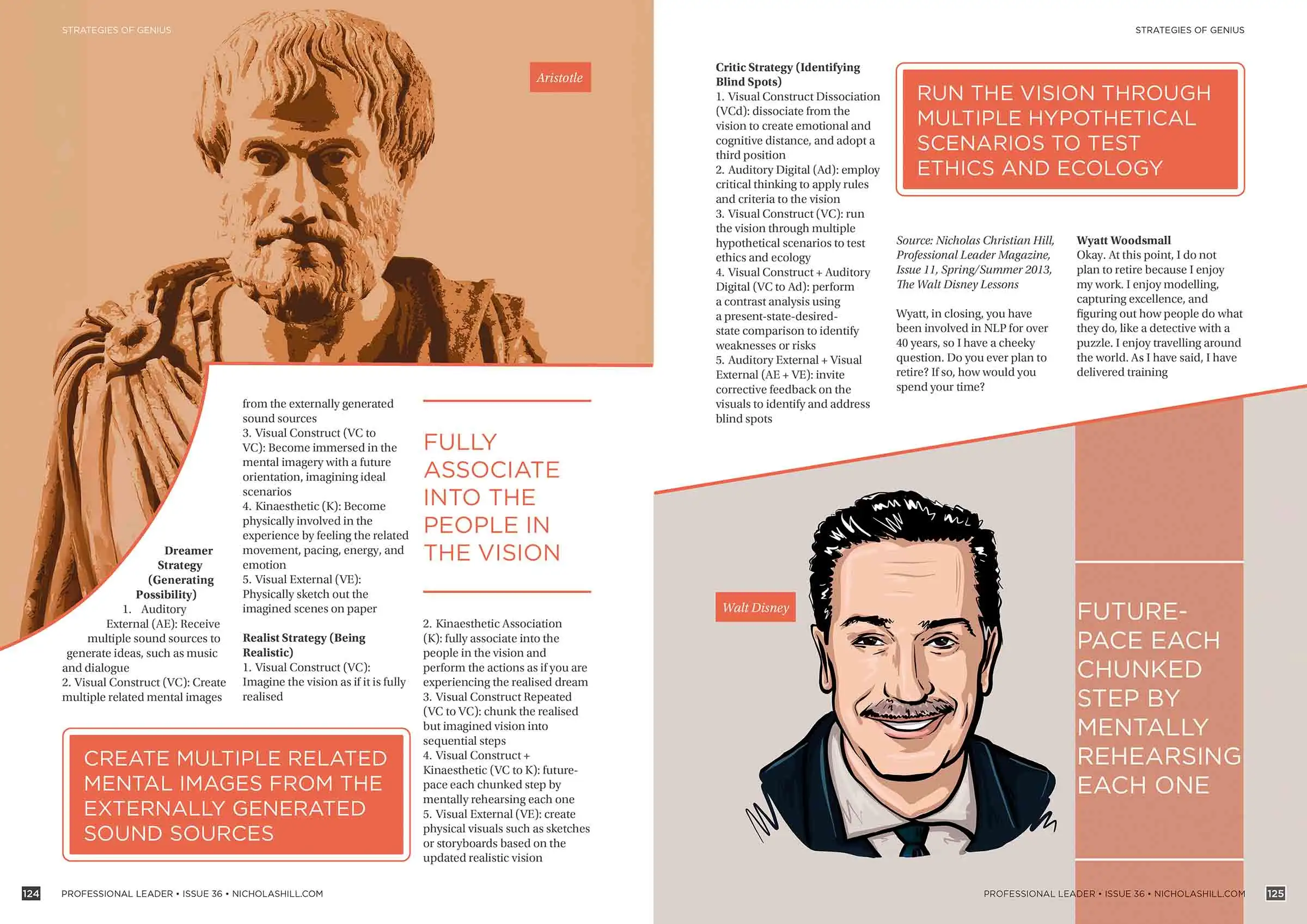
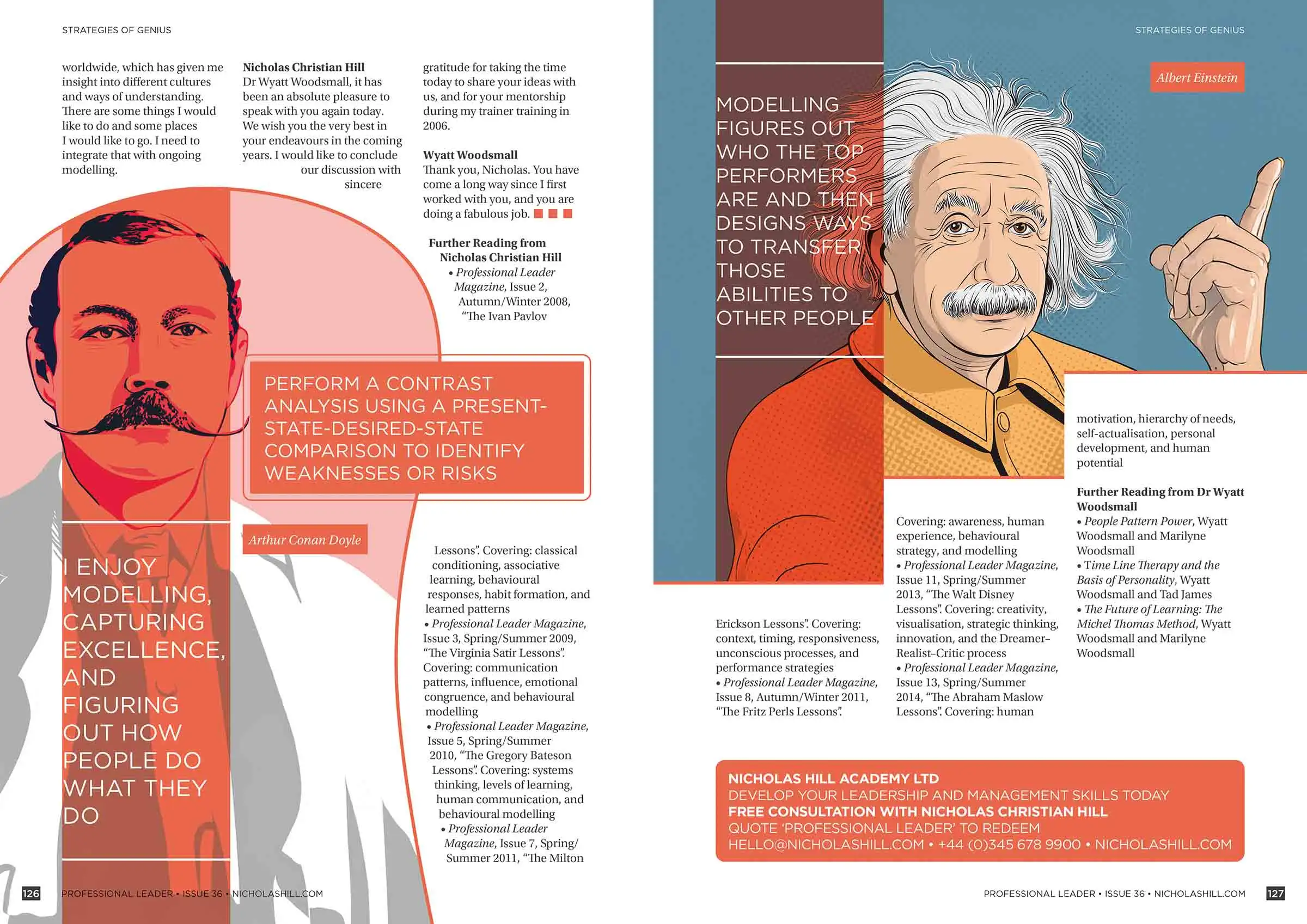
To conclude our discussion today, I would like to turn our attention to Robert Dilts’ excellent work, Strategies of Genius Volume I and Volume II, which sit on my shelf behind me. Dilts modelled the thinking strategies of historical geniuses including Aristotle, Albert Einstein, Walt Disney, Wolfgang Amadeus Mozart, and Sir Arthur Conan Doyle's Sherlock Holmes. Dilts highlighted Aristotle’s ability to categorise experience, define first principles, and move systematically from observation to abstraction. Dilts showed that Doyle’s creativity rested on disciplined observation, the elimination of assumptions, and the ability to move from sensory detail to logical conclusion. Dilts found that Mozart composed by hearing complete musical structures internally, then refining them through iterative variation. If I may, I will now share his study on Disney. Dilts uses the coded strategies we have been discussing today. Also, what’s clear from these books is that, because Dilts is modelling other people, he is applying Outside Modelling, as you do, Wyatt. However, because the subjects are deceased, he can only deconstruct what they did through Modelling 1. To undertake Modelling 2, he must infer how they did it from their published material. Using Disney’s tendency to adopt the roles of the Dreamer, Realist, or Critic in board meetings, Dilts determined the following strategies, which I will break down as follows: VAK These references point to the three primary sensory modalities for coding and interpreting experience:
- V (Visual): includes images, colour, shape, movement, spatial relationships
- A (Auditory): includes sounds, words, tone, rhythm
- K (Kinaesthetic): includes physical sensations, balance, movement, bodily feeling
These references clarify whether experience is constructed internally or perceived externally, whether it is associated or dissociated, and whether it involves internal dialogue:
- C = Constructed: internally generated experience (imagining, visualising, creating, simulating)
- E = External: externally perceived experience (seen, heard, or felt in real time)
- a = Associated: experiencing an event from within one's own perspective
- d = Dissociated: experiencing an event from an observer or third-person perspective
- Ad = Auditory Digital: internally generated dialogue, such as self-talk
- Auditory External (AE): Receive multiple sound sources to generate ideas, such as music and dialogue
- Visual Construct (VC): Create multiple related mental images from the externally generated sound sources
- Visual Construct (VC to VC): Become immersed in the mental imagery with a future orientation, imagining ideal scenarios
- Kinaesthetic (K): Become physically involved in the experience by feeling the related movement, pacing, energy, and emotion
- Visual External (VE): Physically sketch out the imagined scenes on paper
- Visual Construct (VC): Imagine the vision as if it is fully realised
- Kinaesthetic Association (K): Fully associate into the people in the vision and perform the actions as if you are experiencing the realised dream
- Visual Construct Repeated (VC to VC): Chunk the realised but imagined vision into sequential steps
- Visual Construct + Kinaesthetic (VC to K): Future-pace each chunked step by mentally rehearsing each one
- Visual External (VE): Create physical visuals such as sketches or storyboards based on the updated realistic vision
- Visual Construct Dissociation (VCd): Dissociate from the vision to create emotional and cognitive distance, and adopt a third position
- Auditory Digital (Ad): Employ critical thinking to apply rules and criteria to the vision
- Visual Construct (VC): Run the vision through multiple hypothetical scenarios to test ethics and ecology
- Visual Construct + Auditory Digital (VC to Ad): Perform a contrast analysis using a present-state-desired-state comparison to identify weaknesses or risks
- Auditory External + Visual External (AE + VE): Invite corrective feedback on the visuals to identify and address blind spots

Wyatt Woodsmall
Okay. At this point, I do not plan to retire because I enjoy my work. I enjoy modelling, capturing excellence, and figuring out how people do what they do, like a detective with a puzzle. I enjoy travelling around the world. As I have said, I have delivered training worldwide, which has given me insight into different cultures and ways of understanding. There are some things I would like to do and some places I would like to go. I need to integrate that with ongoing modelling.
Nicholas Christian Hill
Dr Wyatt Woodsmall, it has been an absolute pleasure to speak with you again today. We wish you the very best in your endeavours in the coming years. I would like to conclude our discussion with sincere gratitude for taking the time today to share your ideas with us, and for your mentorship during my trainer training in 2006.
Wyatt Woodsmall
Thank you, Nicholas. You have come a long way since I first worked with you, and you are doing a fabulous job.