



Eliciting Performance Strategies









































































Nicholas Christian Hill
Nicholas Christian Hill FCMI FIoL FIC Managing Director, Nicholas Hill Academy Ltd Leadership and Management Master Trainer Founding Editor, Professional Leader Magazine

Dr Wyatt Woodsmall
Certified Master Modeller Co-Creator, Advanced Behavioural Modelling Co-Founder, International NLP Trainers Association Co-Author, Time Line Therapy and the Basis of Personality

Nicholas Christian Hill
Okay. Both Inside and Outside Modelling require the modeller to elicit the syntax, which comprises internal processes, internal states, and external behaviour. We often refer to this process as strategy elicitation. In this context, we mean performance strategy rather than organisational strategy. Wyatt, please provide us with an explanation of this terminology.

Wyatt Woodsmall
A strategy is a sequence of representational systems and associated physiological states organised towards a specific outcome. There is probably as much confusion about strategies as there is about modelling. Sometimes, people put the cart before the horse. You can achieve anything with the right strategy. Strategies do not work unless you can use the representational systems that are sequenced in the strategy. The first skill you need to develop is the ability to make refined discriminations within each representational system. If you can do this, you can combine these into strategies.
Nicholas Christian Hill
Let me pause you there, if I may, because the term representational system needs unpacking if this is going to make sense to others. In simple terms, representational systems are the human sensory faculties that process sensory experience. We are talking about visual, auditory, kinaesthetic, and, to a lesser extent, olfactory and gustatory information. This name reminds us that human senses only represent the world. Our interpretation, therefore, is not reality. When someone thinks, decides, or acts, they rely on one or more of these systems internally. So, when you say a performance strategy is a sequence of representational systems, you are describing the order in which a person sees, hears, and feels information to produce an outcome. What is often overlooked in training is that people may understand the steps of the strategy but lack sufficient sensory acuity in practice. Wyatt, please provide an example of a simple strategy that we can all relate to.
Wyatt Woodsmall
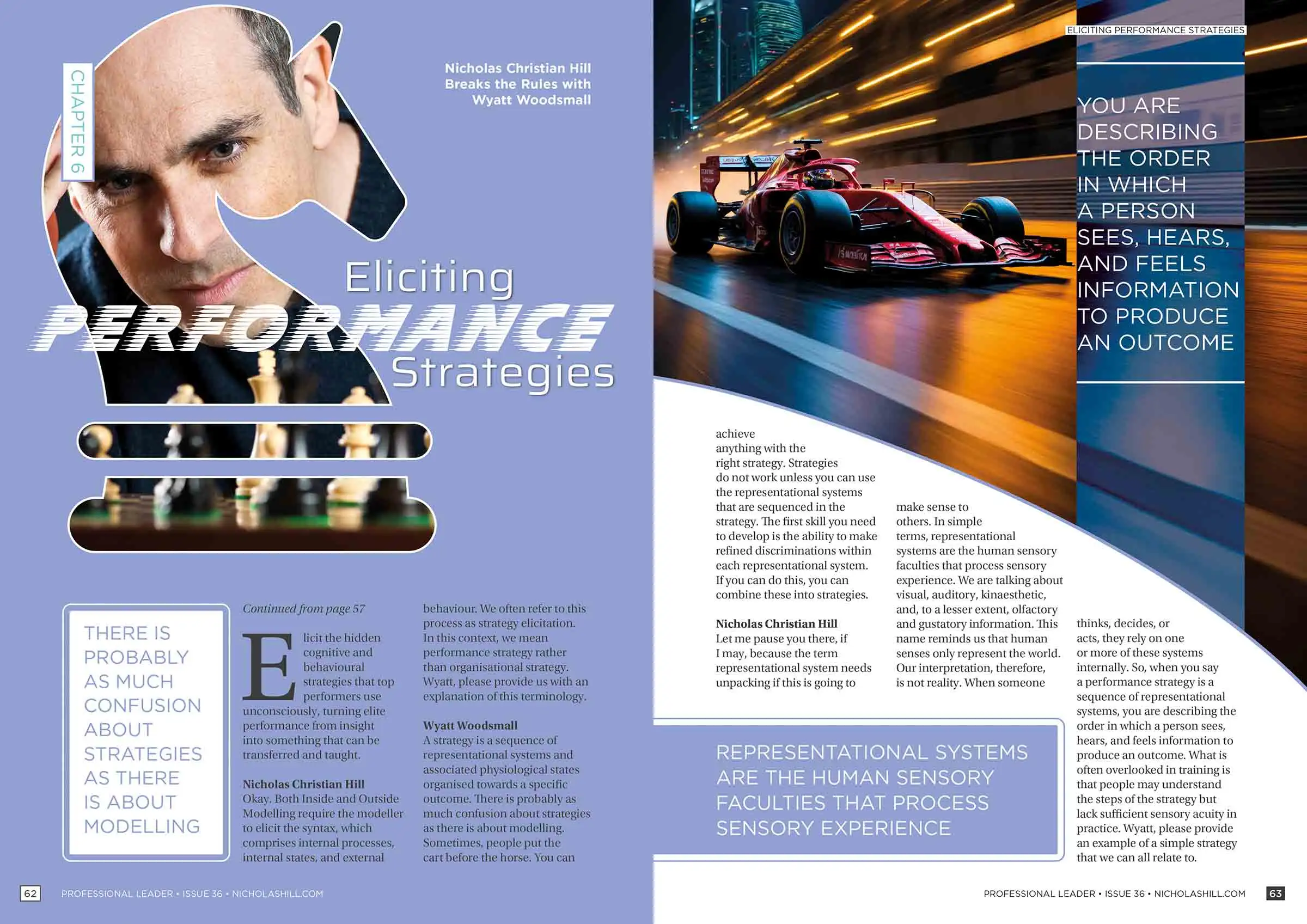
Of course. The standard strategy you can use is the spelling strategy, in which you are asked to spell the word. You can look up and see an image of the word and then read it aloud. This is a poor example because it is the simplest case. It occurs in the shortest timeframe. Almost no strategies are that simple. Many strategies can be implemented over days, weeks, or even months, making them much more difficult to track. If it happens instantly, you can use the spelling strategy. That is an example of a strategy.
Nicholas Christian Hill
The spelling strategy is helpful because it shows the structure clearly. Another example I have used is driving a car. Someone might know how to reach a destination, but if they were to write down the strategy to get there, it would run into hundreds of pages. This is why learning to drive typically requires several lessons for most of us. The strategy would include how to respond mentally and physiologically to other vehicles, landmarks, pedestrians, and street names. It would consist of a kinaesthetic component, such as a sense of when to turn, apply the brakes, speed up, or slow down. That sequence may run automatically, out of unconscious competence, as we have discussed, but it remains a strategy grounded in representational systems.
Wyatt Woodsmall
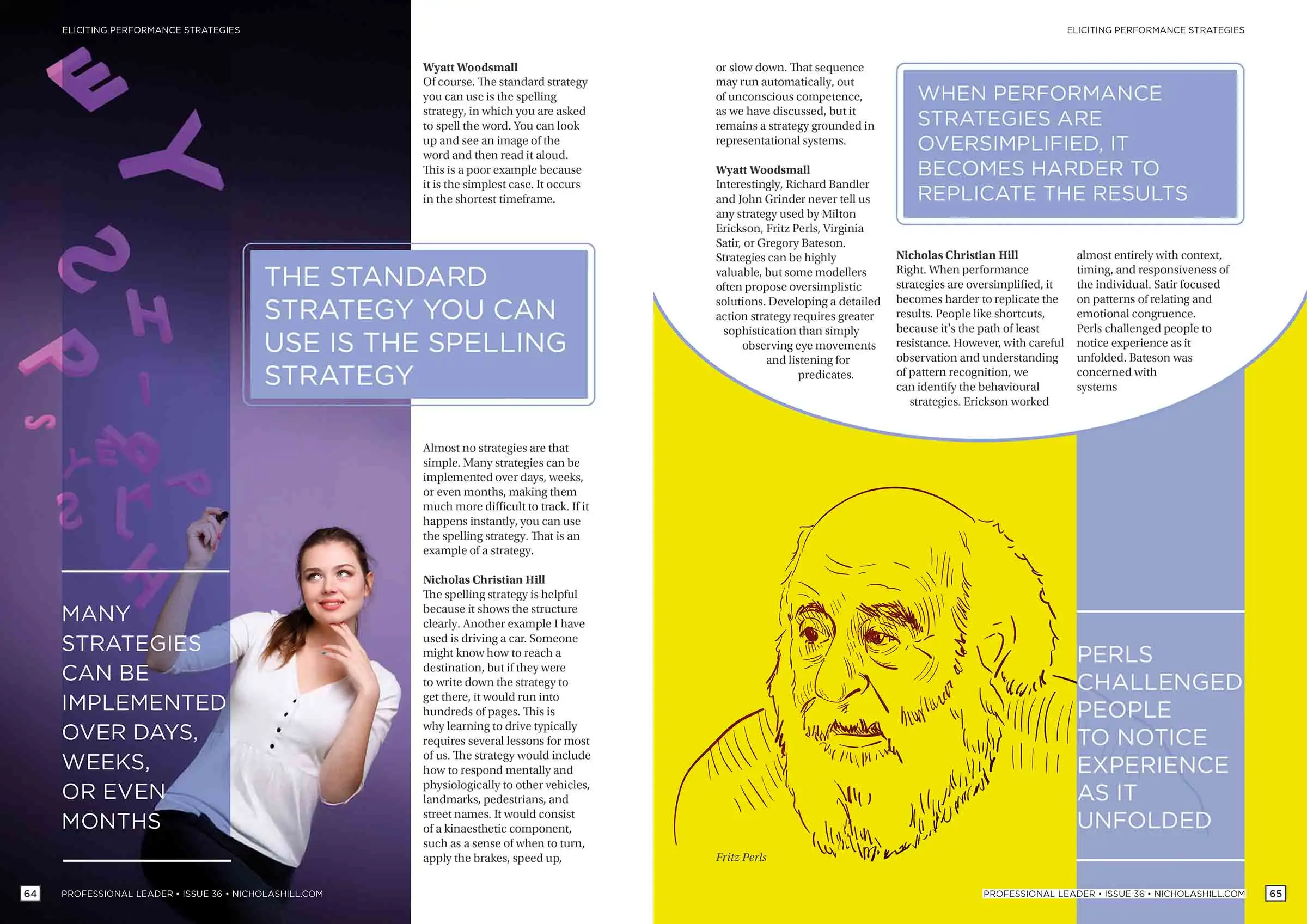
Interestingly, Richard Bandler and John Grinder never tell us any strategy used by Milton Erickson, Fritz Perls, Virginia Satir, or Gregory Bateson. Strategies can be highly valuable, but some modellers often propose oversimplistic solutions. Developing a detailed action strategy requires greater sophistication than simply observing eye movements and listening for predicates.
Nicholas Christian Hill
Right. When performance strategies are oversimplified, it becomes harder to replicate the results. People like shortcuts, because it's the path of least resistance. However, with careful observation and understanding of pattern recognition, we can identify the behavioural strategies. Erickson worked almost entirely with context, timing, and responsiveness of the individual. Satir focused on patterns of relating and emotional congruence. Perls challenged people to notice experience as it unfolded. Bateson was concerned with systems and levels of learning. We would all have benefited from knowing the internal strategies used by these giants. Please elaborate on how professionals use performance strategies to achieve success.
Wyatt Woodsmall
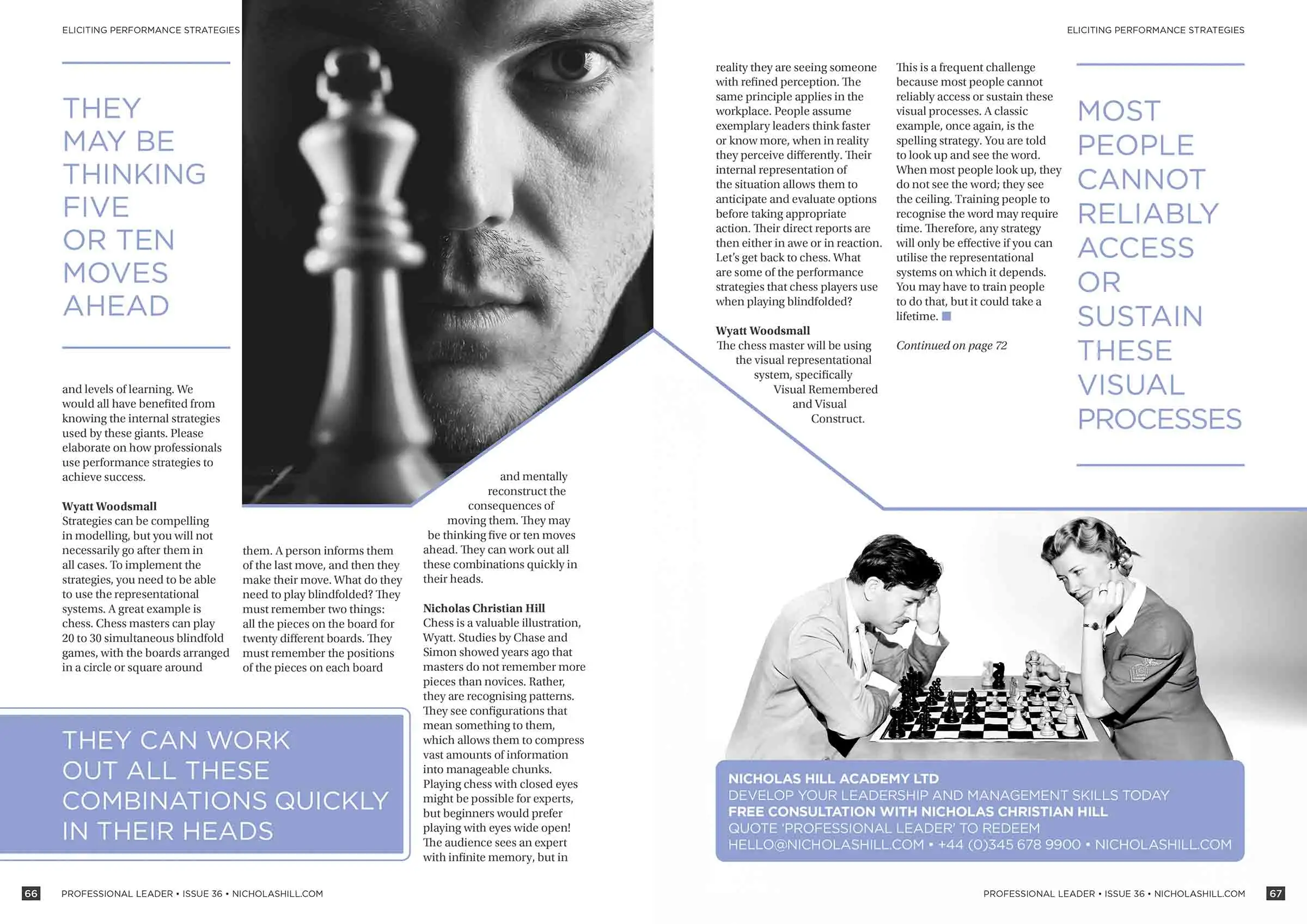
Strategies can be compelling in modelling, but you will not necessarily go after them in all cases. To implement the strategies, you need to be able to use the representational systems. A great example is chess. Chess masters can play 20 to 30 simultaneous blindfold games, with the boards arranged in a circle or square around them. A person informs them of the last move, and then they make their move. What do they need to play blindfolded? They must remember two things: all the pieces on the board for twenty different boards. They must remember the positions of the pieces on each board and mentally reconstruct the consequences of moving them. They may be thinking five or ten moves ahead. They can work out all these combinations quickly in their heads.
Nicholas Christian Hill
Chess is a valuable illustration, Wyatt. Studies by Chase and Simon showed years ago that masters do not remember more pieces than novices. Rather, they are recognising patterns. They see configurations that mean something to them, which allows them to compress vast amounts of information into manageable chunks. Playing chess with closed eyes might be possible for experts, but beginners would prefer playing with eyes wide open! The audience sees an expert with infinite memory, but in reality they are seeing someone with refined perception. The same principle applies in the workplace. People assume exemplary leaders think faster or know more, when in reality they perceive differently. Their internal representation of the situation allows them to anticipate and evaluate options before taking appropriate action. Their direct reports are then either in awe or in reaction. Let’s get back to chess. What are some of the performance strategies that chess players use when playing blindfolded?
Wyatt Woodsmall
The chess master will be using the visual representational system, specifically Visual Remembered and Visual Construct. This is a frequent challenge because most people cannot reliably access or sustain these visual processes. A classic example, once again, is the spelling strategy. You are told to look up and see the word. When most people look up, they do not see the word; they see the ceiling. Training people to recognise the word may require time. Therefore, any strategy will only be effective if you can utilise the representational systems on which it depends. You may have to train people to do that, but it could take a lifetime.