



Developing Visualisation Skills









































































Nicholas Christian Hill
Nicholas Christian Hill FCMI FIoL FIC Managing Director, Nicholas Hill Academy Ltd Leadership and Management Master Trainer Founding Editor, Professional Leader Magazine

Dr Wyatt Woodsmall
Certified Master Modeller Co-Creator, Advanced Behavioural Modelling Co-Founder, International NLP Trainers Association Co-Author, Time Line Therapy and the Basis of Personality

Nicholas Christian Hill
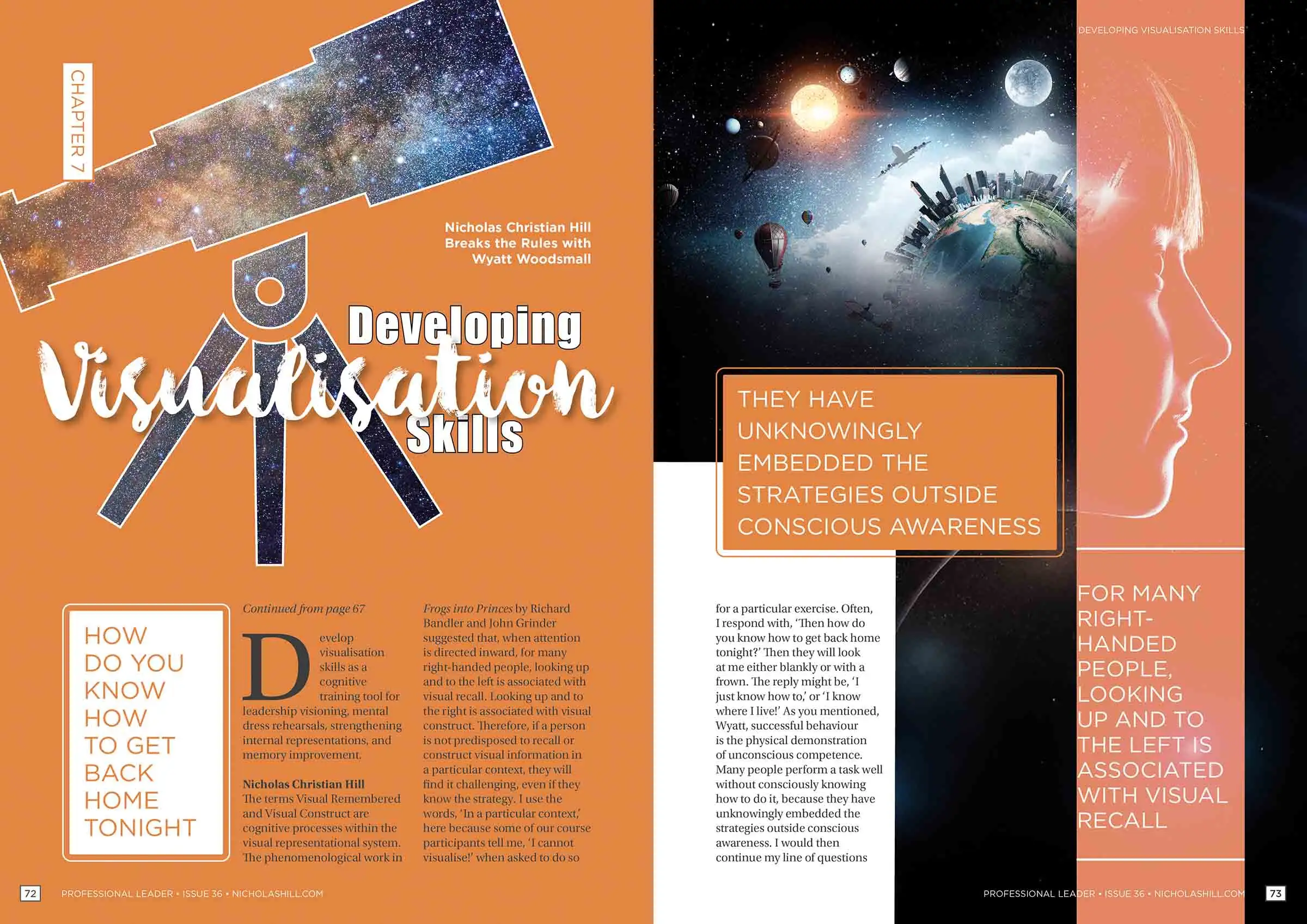
The terms Visual Remembered and Visual Construct are cognitive processes within the visual representational system. The phenomenological work in Frogs into Princes by Richard Bandler and John Grinder suggested that, when attention is directed inward, for many right-handed people, looking up and to the left is associated with visual recall. Looking up and to the right is associated with visual construct. Therefore, if a person is not predisposed to recall or construct visual information in a particular context, they will find it challenging, even if they know the strategy. I use the words, ‘In a particular context,’ here because some of my course participants tell me, ‘I cannot visualise!’ when asked to do so for a particular exercise. Often, I respond with, ‘Then how do you know how to get back home tonight?’ Then they will look at me either blankly or with a frown. The reply might be, ‘I just know how to,’ or ‘I know where I live!’ As you mentioned, Wyatt, successful behaviour is the physical demonstration of unconscious competence. Many people perform a task well without consciously knowing how to do it, because they have unknowingly embedded the strategies outside conscious awareness. I would then continue my line of questions with something like, ‘As you exit this building, what will you see directly in front of you?’ After they have answered that question, I might also ask, ‘On your journey home, which will be the first set of traffic lights that you see?’ To respond to the questions, they have no choice but to access the information by looking upwards and internally, before giving me the answers. I might then ask the person to explain how they were able to provide those answers. Typical responses would be, ‘I could see it in my head.’ At that point, I smile and say, ‘So you thought you could not visualise!’ This process prompts the student to question whether they can apply the same strategy to a different context. That is all I need to begin the next step in developing their visualisation skills. Wyatt, please elaborate on the challenges you encounter in developing sensory performance.

Wyatt Woodsmall
Qualifying the axiom I used earlier, ‘Possible in the world, possible for me, only a matter of how,’ I would add, ‘How many years will it take to develop the required representational system ability?’ You cannot train people in the strategy until you can train them to make the necessary representational distinctions. It’s difficult because you have spent your entire life developing and practising the representational systems you are using. If you are going to get better, it may require a lifetime. These are some of the real-world challenges of modelling and, arguably, the greatest challenge of using strategies.
Nicholas Christian Hill
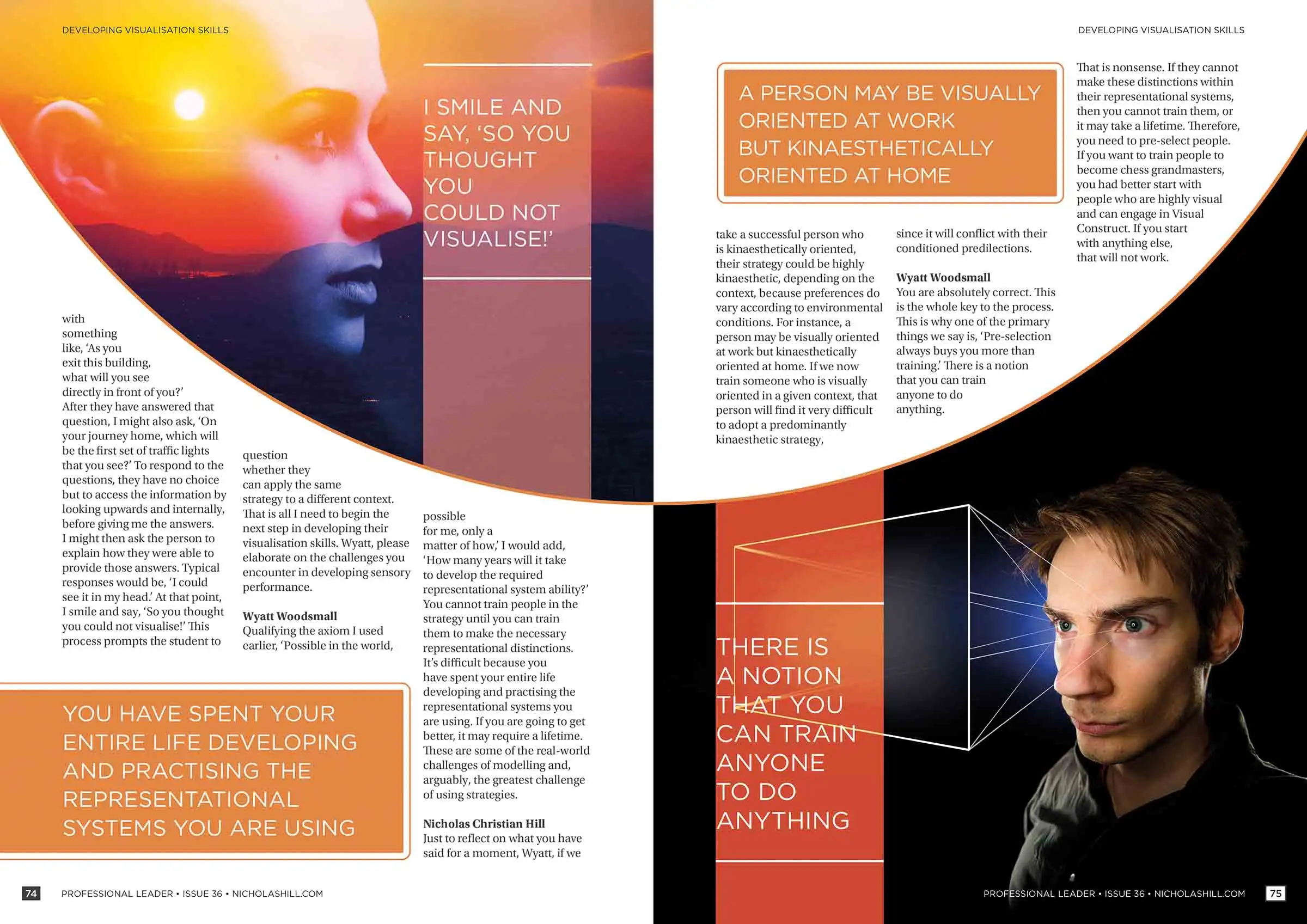
Just to reflect on what you have said for a moment, Wyatt, if we take a successful person who is kinaesthetically oriented, their strategy could be highly kinaesthetic, depending on the context, because preferences do vary according to environmental conditions. For instance, a person may be visually oriented at work but kinaesthetically oriented at home. If we now train someone who is visually oriented in a given context, that person will find it very difficult to adopt a predominantly kinaesthetic strategy, since it will conflict with their conditioned predilections.
Wyatt Woodsmall
You are absolutely correct. This is the whole key to the process. This is why one of the primary things we say is, ‘Pre-selection always buys you more than training.’ There is a notion that you can train anyone to do anything. That is nonsense. If they cannot make these distinctions within their representational systems, then you cannot train them, or it may take a lifetime. Therefore, you need to pre-select people. If you want to train people to become chess grandmasters, you had better start with people who are highly visual and can engage in Visual Construct. If you start with anything else, that will not work.
Nicholas Christian Hill
Yes. Given differing sensory preferences, a person may have a strategy but be unable to adopt it naturally. This notion has clear implications for recruitment. Some organisations hire based on experience or attitude, then expect training to do the heavy lifting. What is frequently overlooked is whether the person can process information in a manner the role demands. I have seen capable people struggle not through lack of desire or effort, but because the job imposed demands that conflicted with their cognitive biases or conditioning. This does not mean they cannot be trained. It simply means the incline is much steeper.
Wyatt Woodsmall
Yes. In fact, relatively few people will be able to adopt that strategy naturally and will need training.
Nicholas Christian Hill
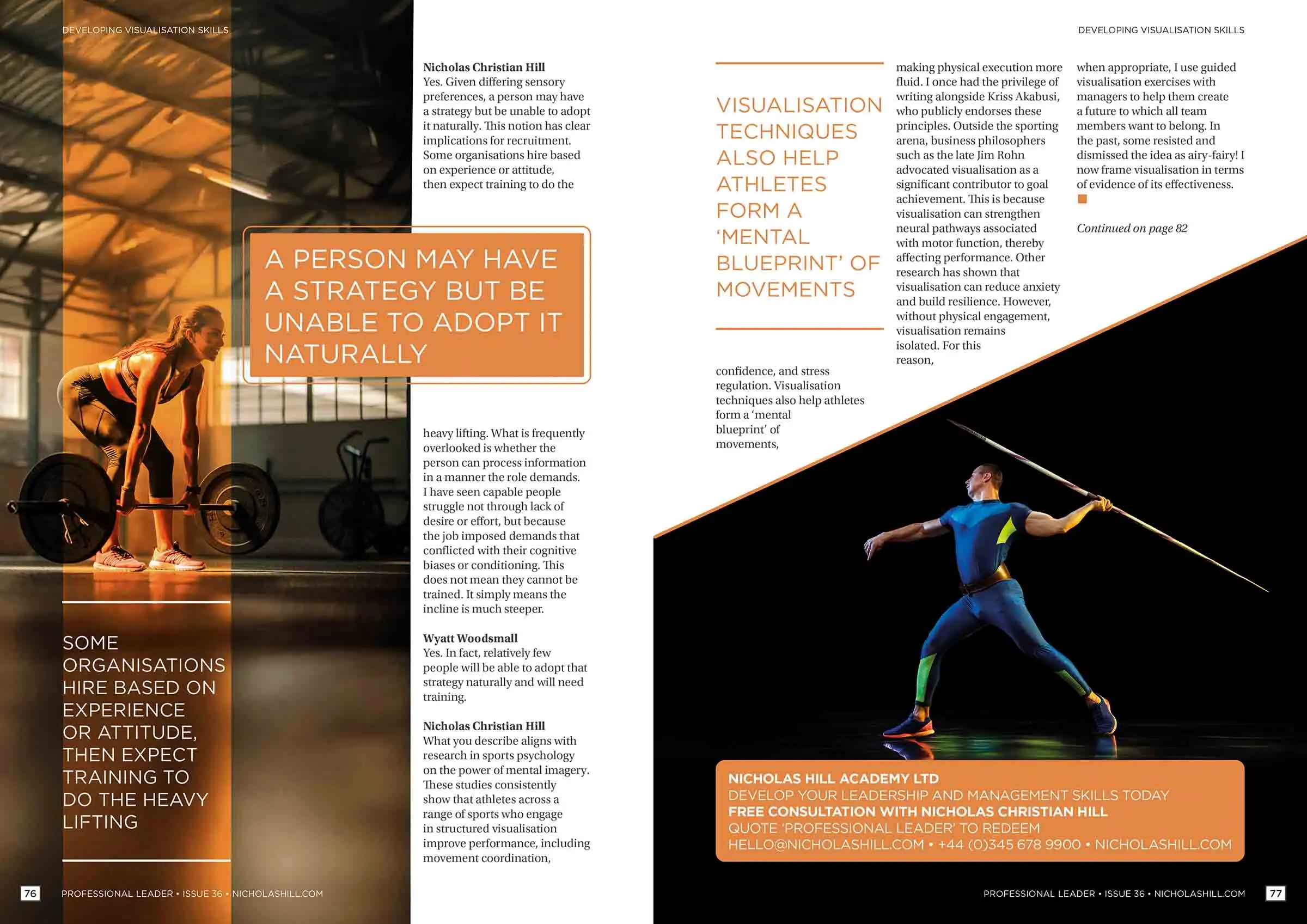
What you describe aligns with research in sports psychology on the power of mental imagery. These studies consistently show that athletes across a range of sports who engage in structured visualisation improve performance, including movement coordination, confidence, and stress regulation. Visualisation techniques also help athletes form a ‘mental blueprint’ of movements, making physical execution more fluid. I once had the privilege of writing alongside Kriss Akabusi, who publicly endorses these principles. Outside the sporting arena, business philosophers such as the late Jim Rohn advocated visualisation as a significant contributor to goal achievement. This is because visualisation can strengthen neural pathways associated with motor function, thereby affecting performance. Other research has shown that visualisation can reduce anxiety and build resilience. However, without physical engagement, visualisation remains isolated. For this reason, when appropriate, I use guided visualisation exercises with managers to help them create a future to which all team members want to belong. In the past, some resisted and dismissed the idea as airy-fairy! I now frame visualisation in terms of evidence of its effectiveness.