



Presenting Science or Pseudoscience








































































Nicholas Christian Hill
Nicholas Christian Hill FCMI FIoL FIC Managing Director, Nicholas Hill Academy Ltd Leadership and Management Master Trainer Founding Editor, Professional Leader Magazine

Dr Wyatt Woodsmall
Certified Master Modeller Co-Creator, Advanced Behavioural Modelling Co-Founder, International NLP Trainers Association Co-Author, Time Line Therapy and the Basis of Personality


Nicholas Christian Hill
Wyatt, let’s consider the future of NLP. Where do you see it going?
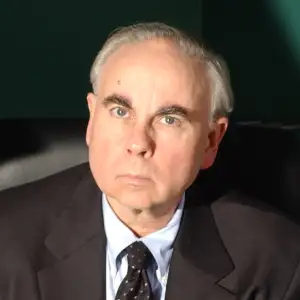
Wyatt Woodsmall
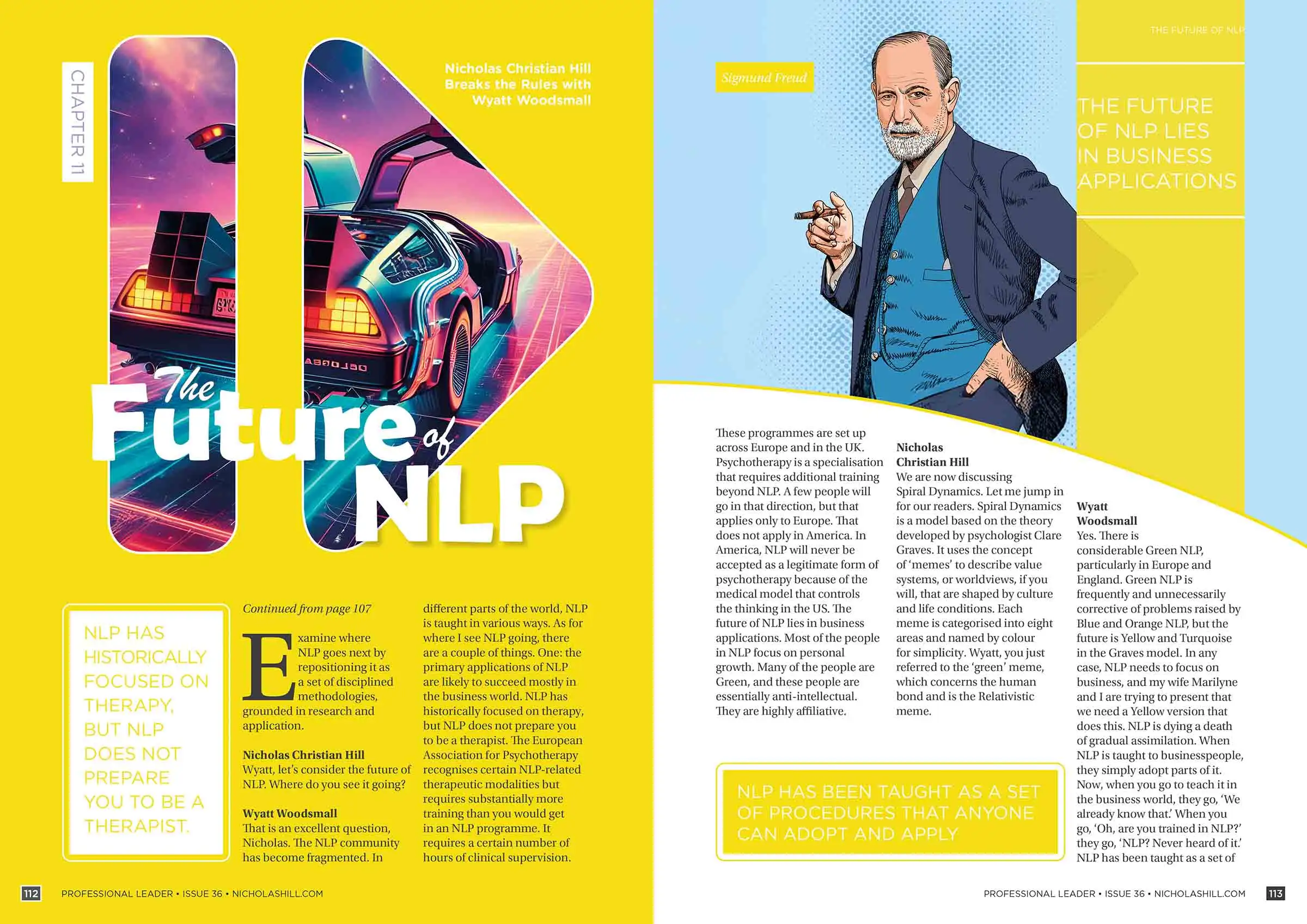
That is an excellent question, Nicholas. The NLP community has become fragmented. In different parts of the world, NLP is taught in various ways. As for where I see NLP going, there are a couple of things. One: the primary applications of NLP are likely to succeed mostly in the business world. NLP has historically focused on therapy, but NLP does not prepare you to be a therapist. The European Association for Psychotherapy recognises certain NLP-related therapeutic modalities but requires substantially more training than you would get in an NLP programme. It requires a certain number of hours of clinical supervision. These programmes are set up across Europe and in the UK. Psychotherapy is a specialisation that requires additional training beyond NLP. A few people will go in that direction, but that applies only to Europe. That does not apply in America. In America, NLP will never be accepted as a legitimate form of psychotherapy because of the medical model that controls the thinking in the US. The future of NLP lies in business applications. Most of the people in NLP focus on personal growth. Many of the people are Green, and these people are essentially anti-intellectual. They are highly affiliative.
Nicholas Christian Hill
We are now discussing Spiral Dynamics. Let me jump in for our readers. Spiral Dynamics is a model based on the theory developed by psychologist Clare Graves. It uses the concept of ‘memes’ to describe value systems, or worldviews, if you will, that are shaped by culture and life conditions. Each meme is categorised into eight areas and named by colour for simplicity. Wyatt, you just referred to the ‘green’ meme, which concerns the human bond and is the Relativistic meme.
Wyatt Woodsmall
Yes. There is considerable Green NLP, particularly in Europe and England. Green NLP is frequently and unnecessarily corrective of problems raised by Blue and Orange NLP, but the future is Yellow and Turquoise in the Graves model. In any case, NLP needs to focus on business, and my wife Marilyne and I are trying to present that we need a Yellow version that does this. NLP is dying a death of gradual assimilation. When NLP is taught to businesspeople, they simply adopt parts of it. Now, when you go to teach it in the business world, they go, ‘We already know that.’ When you go, ‘Oh, are you trained in NLP?’ they go, ‘NLP? Never heard of it.’ NLP has been taught as a set of procedures that anyone can adopt and apply. The problem is that NLP has not been taught as a science, with supporting concepts, principles, or processes.
Nicholas Christian Hill
Please allow me to summarise the meanings of those other colours to which you have referred. ‘Blue’ is purposeful, whilst ‘Orange’ is strategic, so both conflict with the anti-intellectual ‘Green’. Wyatt, you refer to the future of NLP as ‘Yellow,’ which is systemic, and ‘Turquoise,’ which is holistic, both of which belong to the evolved second tier in the Graves model. Wyatt, you mentioned how many practitioners have reduced NLP to simply a set of procedures. Are you referring specifically to techniques?
Wyatt Woodsmall
Yes. Anybody can take over techniques. On one level, it is highly successful because people in the culture have adopted it and follow it. On another level, because they are not labelling it as NLP, the techniques are being assimilated without any understanding of the science behind them. Also, it happened because most early NLP Trainers were all Green, which is why NLP got a bad reputation in the business world to start with. They believed that business was bad and that money was the root of all evil. When they began teaching businesspeople, they thought they were converting them to their worldview. Businesspeople are not stupid, so they were offended by this. They decided, ‘We do not need this.’ Well, you need it if you are going to do NLP for business; you have to be able to do an Orange form of NLP that appreciates money and appreciates where businesspeople operate from, and that is adapted to that values system and that culture. You put a bunch of Green NLP Practitioners and a bunch of Orange NLP Practitioners in the same room, and immediately, a war develops. Green decides that Orange is unethical, and Orange decides that Green is totally naive and hopeless. It is a real mess.
Nicholas Christian Hill
Yes. It is a mess, yet it is also somewhat of a surprise, since NLP Master Practitioners must operate from an objective perspective, with respect for various psychological ‘maps’ of the world. This respect often matures into curiosity and necessitates investigating the probable causes that underpin the beliefs and values that drive the behaviour of those who operate from Green, Orange, or other paradigms. In fact, my answer to those quizzical clients is that their negative experience with NLP may have been due to malpractice by certain practitioners, rather than by trainers. I am surprised to find such clients asking me what the difference is between the two titles. I reply with ‘the trainer trains the practitioner,’ and we expect the former to have significantly more knowledge and experience. So, Wyatt, where is NLP going in all of this confusion?
Wyatt Woodsmall
NLP is going in several different directions. Which one will eventually win out? That is the problem, because one creates problems for the other. So if you do Orange NLP, then Green gets all upset and says, ‘This is an abuse of NLP, this is unethical, and we do not want this.’ Whereas Orange goes, ‘These people are touchy-feely, these people are airy-fairy, and if this is NLP, then we do not want anything to do with this, because these people are hopelessly naive.’ We see the same value conflicts we find in society, in NLP. Eventually, what will win out? We are not sure. Ken Wilber says if we can get another several per cent of the population from Green to move into Yellow, that will cross the threshold, and the movement will upscale everyone. It may be happening, but it is taking longer than I would like.
Nicholas Christian Hill
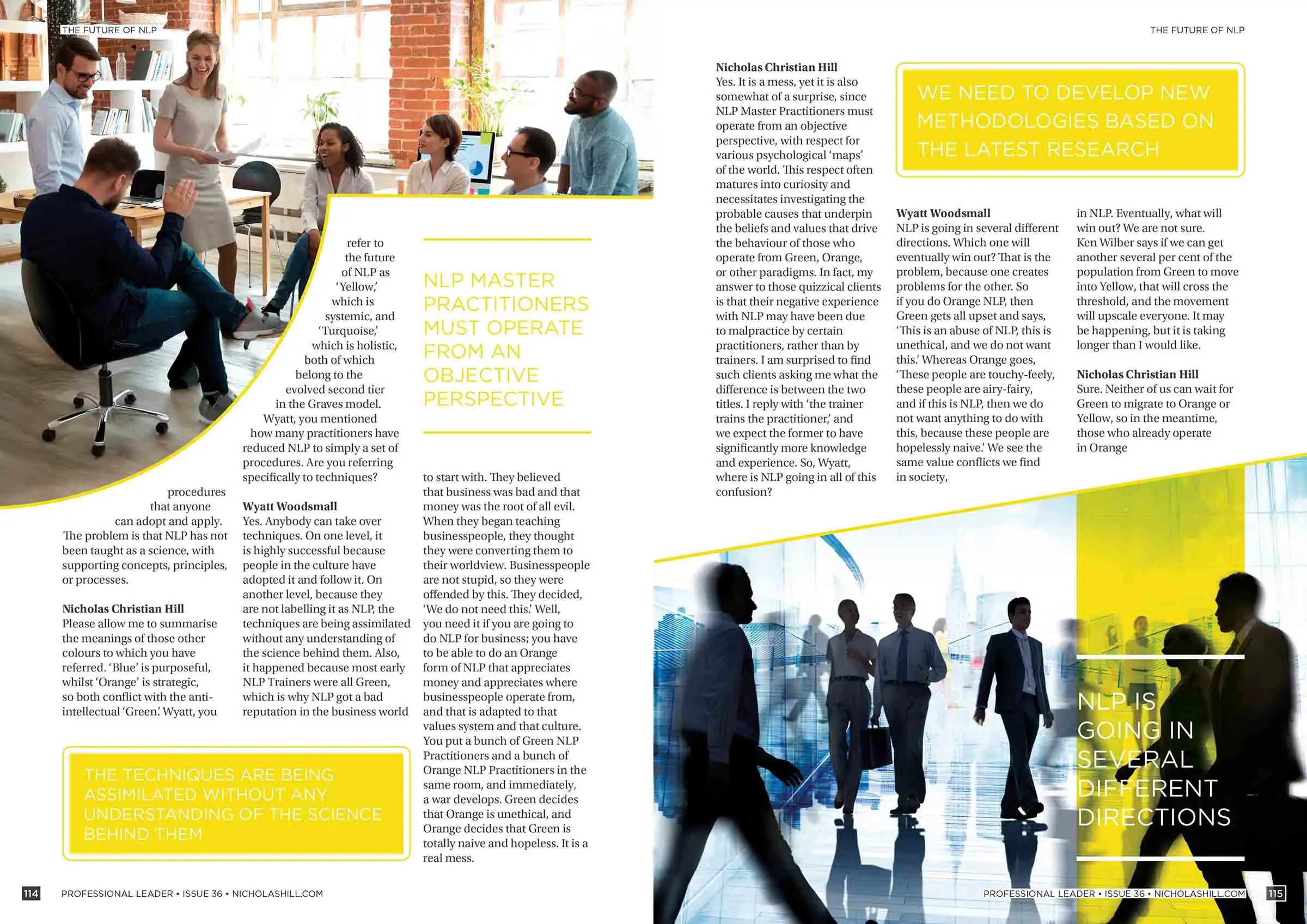
Sure. Neither of us can wait for Green to migrate to Orange or Yellow, so in the meantime, those who already operate in Orange or Yellow paradigms can integrate NLP frameworks with leadership and management models. You said that NLP is dying through assimilation. On the other hand, it may be the only way to sustain the lifeblood of these valuable models. Green could undo any good work carried out by Yellow NLP Practitioners anyway. Perhaps Yellow should build on what we know and start from where the world is today. This means we need to develop new methodologies based on the latest research. In the meantime, if we continue to share NLP models, then we must communicate the scientific principles and processes to validate claims and support the results we achieve.
Nicholas Christian Hill
Training providers must be creative when adopting NLP models in their training courses. Let me give you some examples of how our clients find it useful. NLP models, such as well-formed outcomes, are beneficial for goal setting, framing and reframing for change management, anchoring for emotional intelligence, rapport and positive communication for conflict management, chunking for negotiation, the feedback model and perceptual positions for performance management, the Milton Model and Meta Model for advanced communication skills, and modelling for leadership styles. We could list many more, could we not, Wyatt? What are your thoughts on this position?
Wyatt Woodsmall
Well, that is the direction I am going in. That is the direction I would like to see NLP go in. Unfortunately, there are too many of the personal growth people out there. There is nothing wrong with personal growth, but they believe their model is the only one. We need to recognise that there are different models of the world, as NLP discusses, but NLP does not necessarily respect or understand these models, nor does it know how to communicate with them. NLP is powerful in sales. It is powerful in negotiation. I modelled a man who was the top salesman in his industry’s history, selling half a billion dollars’ worth of product in five years. He came up with a high-end sales training, called the Rainmaker Seminar, which was based on what a super-salesman actually did, as opposed to all sales training that is based on somebody’s theory of what works. Once, a woman attended the training and returned within a week. She had closed a ten-million-dollar sale. We asked, ‘How did you do this?’ She said, ‘All I did was exactly what you told me.’
Nicholas Christian Hill
That is a perfect example of the many claims from Green NLP Practitioners, who simply state that, ‘NLP works. Who cares about scientific validity?’ Before we close our discussion, earlier on, we mentioned Wikipedia’s article on NLP. I find it extraordinary that Wikipedia dismisses NLP as a pseudoscience, yet it hosts well-referenced articles on many NLP models. Topics such as chunking, rapport, representational systems, modelling, framing, and reframing, to name just a few, appear in Wikipedia without any reference to pseudoscience. This seems to be a contradiction. However, labelling NLP as a pseudoscience should not prevent further scientific investigation by those operating from Orange or Yellow into the millions of claims made in its favour. Furthermore, we now have 40 years of historical documents from thousands of NLP Practitioners, whether Green or Yellow, testifying to the efficacy of NLP tools, regardless of whether the trainer uses scientific principles to substantiate their claims. In light of this, I choose to refer to NLP as an ideology rather than a science, given the subjective nature of experience when using NLP tools. Frankly, we would not have this problem if we had never referred to NLP as a science in the first place. As you have indicated, Wyatt, those people operating inside Green models of the world will not care about this evident industry dilemma anyway.