Website Under Construction

Wyatt Woodsmall Interview Transcript

Human Authored Editorial Content
Facebook
X
LinkedIn
Email
WhatsApp
Pinterest

Professional Leader Magazine Issues 36

Dr Wyatt Woodsmall is a Certified Master Modeller, co-creator of Advanced Behavioural Modelling, and an internationally recognised trainer and consultant. His work focuses on capturing and transferring excellence, behavioural performance, and the influence of culture on human performance. Over more than five decades, he has trained professionals across government, business and elite sport, including work with the U.S. Diving Team at three Olympics. He has also authored several influential books on behavioural modelling, personality and learning.

© Nicholas Hill Academy Ltd, England, UK, 2015-2026

65 Minute Read

Wyatt Woodsmall Interview Transcript

Issue 32 Advertising Partners

Featured Brands

Exclusive Reader Offers

While inclusion does not imply endorsement, the advertisers featured below appear in the current issue of Professional Leader Magazine and offer products or services designed to support your organisation or career. Click the links below to visit their websites and access the limited offers and discounts available to you.

Learn More

FREE Bespoke Furniture Samples

Learn More

FREE Website Marketing Review

Learn More

GUARANTEED B2B Lead Generation

Learn More

ELEVATE Your Brand Design

Learn More

FREE Brand & Trademark Risk Review

Learn More

FREE Business Accounting Consultation

Learn More

SELL Your Spare Business Capacity

Learn More

FREE Business Growth Barrier Audit

Learn More

FREE Social Selling Success Audiobook

Learn More

FREE Business Financial Health Review

Learn More

FREE Protect Your Hearing Guide

Learn More

FREE Team Retreat Planning Checklist

In Conversation with Wyatt Woodsmall

Nicholas Hill DP

Nicholas Christian Hill

Nicholas Christian Hill FCMI FIoL FIC
Managing Director, Nicholas Hill Academy Ltd
Leadership and Management Master Trainer
Editor, Professional Leader Magazine

Dr Wyatt Woodsmall

Certified Master Modeller
Co-Creator, Advanced Behavioural Modelling
Co-Founder, International NLP Trainers Association
Co-Author, Time Line Therapy and the Basis of Personality

Issue 32 Chapter Guide

Wyatt Woodsmall Interview Chapter 1

Conversation Focus

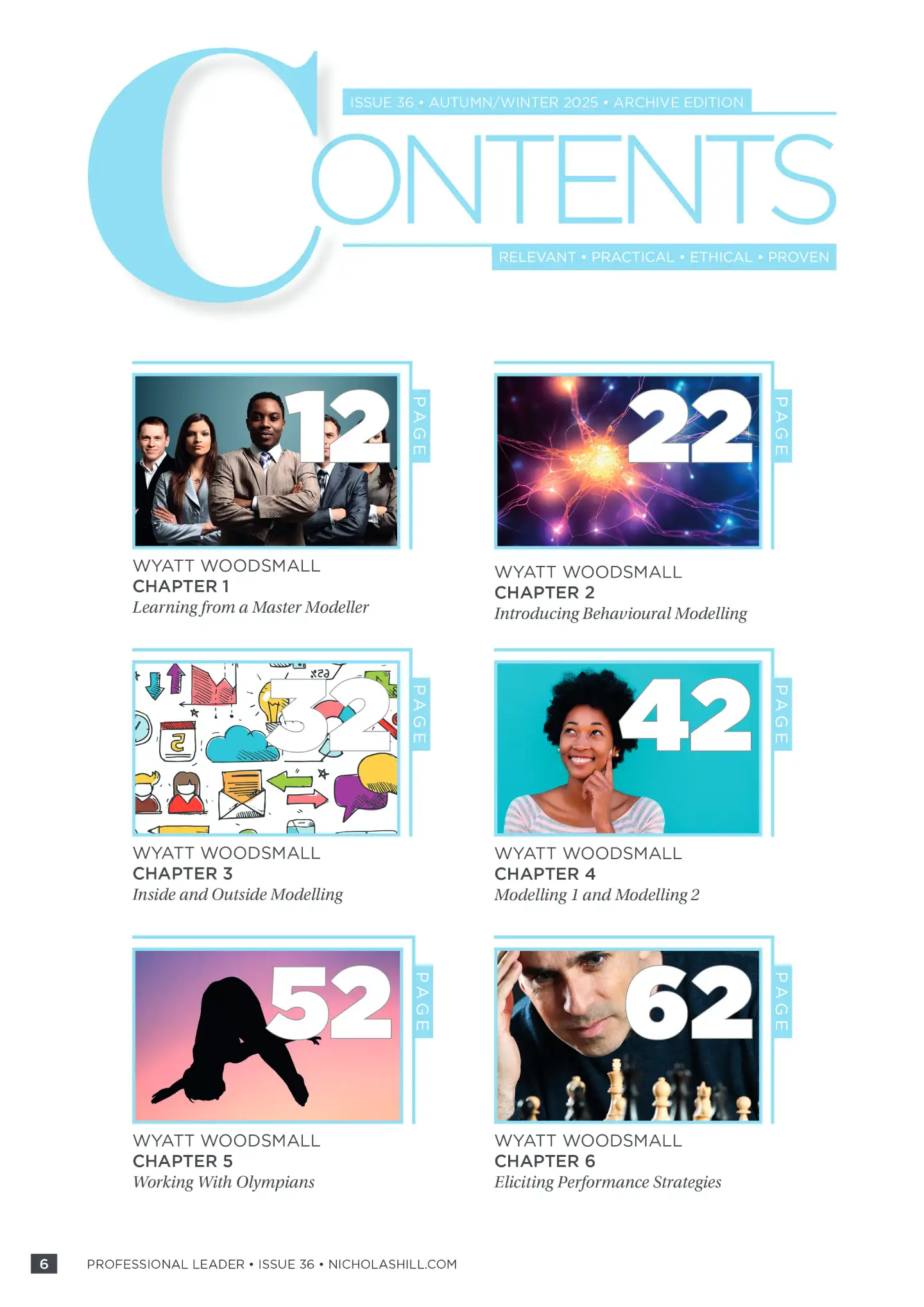
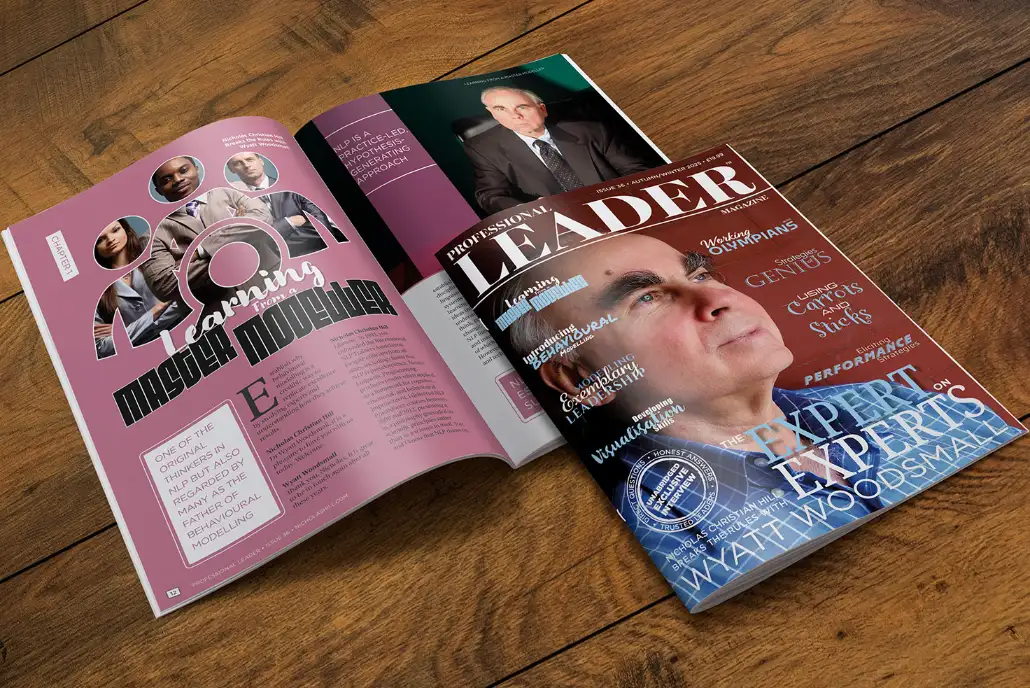
Learning from a Master Modeller

Chapter Overview

Six Pages

Establish why behavioural modelling is a credible way to replicate excellence by studying experts and understanding how they achieve results.

Nicholas Christian Hill

Dr Wyatt Woodsmall, it is a pleasure to have you with us today. Welcome.

Wyatt Woodsmall

Thank you, Nicholas. It is great to be in touch again after all these years.

Nicholas Christian Hill

Likewise. In 1993, you cofounded the International NLP Trainers Association. Despite criticism from all sides, including claims that NLP is pseudoscience, Neuro-Linguistic Programming produces results when applied as a framework for cognitive, emotional, and behavioural improvement. I delivered NLP Practitioner courses between 2008 and 2012, presenting it as a philosophy grounded in scientific principles rather than as a science in itself. You and I know that NLP draws on established disciplines such as linguistics, cognitive psychology, systems theory, and behavioural learning, then packages these ideas into practical tools for understanding how people think, communicate, and change. Some poorly written NLP literature overreached and insulted intelligence, all of which invited criticism. However, many of the concepts and techniques align with researched mechanisms such as cognitive reappraisal and conditioning. When well framed, NLP is a practice-led, hypothesis-generating approach that complements coaching, leadership, and organisational development rather than competing with clinical psychology or neuroscience. Dr Woodsmall, you are not only one of the original thinkers in NLP but also regarded by many as the father of behavioural modelling. Additionally, you are a ‘master modeller’. Please explain to us in more detail what you mean by ‘master modeller’.

Wyatt Woodsmall

Okay. I use that title because I hold a certificate signed by Richard Bandler that verifies my status as a master modeller. I was the first person to receive that certification. Several years ago, when I was beginning my modelling career, I worked on a series of projects commissioned by agencies within the US government. We had Richard Bandler involved in a couple of those projects, and, in light of the results, he issued me a certificate as a master modeller.

Nicholas Christian Hill

Dr Richard Bandler, of course, is one of the cofounders of Neuro-Linguistic Programming and was central to shaping how modelling first entered the field. I once had the privilege of shaking his hand and thanking him for his contributions. Much of his early work was based on studying experts and understanding how they achieved results. That pragmatic emphasis over theory influenced how modelling was understood for years afterwards. It also explains why NLP later became misused, as people adopted the language without fully appreciating the research. As an expert in this field, please clarify the role of a master modeller.

Wyatt Woodsmall

Sure. I consider a master modeller to be someone who practises modelling professionally, is paid to do it, and delivers results. Therefore, every NLP Master Practitioner claims they are a modeller. People presumably do modelling projects, but most of these efforts are pretty much ‘Mickey Mouse’, not in-depth, and do not produce a reproducible, marketable product. The business world, which should be the primary outlet for modelling, pays for results. Therefore, it expects you to deliver results that improve performance.

Nicholas Christian Hill

Absolutely. I hope our readers are now clear from the outset that this is not the type of modelling akin to strutting your stuff on the catwalk or pouting in front of the camera! Instead, it’s about improving behavioural, cognitive, or emotional performance. When I delivered NLP Practitioner courses over 15 years ago, some participants would complete a modelling project. However, it was always an introductory exercise, as many had never done modelling before. What I noticed, even back then, was how quickly people underestimated its usefulness in business, resulting in exercises being conducted superficially. There is a big difference between observing surface behaviour and unpacking the internal structure of that behaviour. The learning cycle shows that expertise is achieved when learners achieve unconscious competence, but only after passing through three earlier stages. Once strategies are embedded in the human nervous system, they are difficult to reverse-engineer. When course participants tell me they have completed a ‘modelling project’, I ask whether the strategies can be successfully transferred. Otherwise, they are worth as little as the paper they were scribbled on. How long, Wyatt, have you been modelling professionally?

Wyatt Woodsmall

I have been doing modelling with my wife, Marilyne, now for over 30 years. Therefore, we consider ourselves professional modellers, or master modellers, for several reasons. One, we focus on this. We provide modelling services and have completed professional modelling projects with Olympic teams, the US government, and the British government. I have delivered training in 30 countries worldwide. That is what I mean by master modeller.

Nicholas Christian Hill

From my own experience in leadership and management development, organisations rarely care whether behavioural strategies look good on paper. They care about real-world results and whether team behaviour changes. The Dynamic Transfer Model tells us that skill transfer is a continual and iterative process. Skill transfer can fail if evolving workplace conditions are not taken into account. Leaders must recognise that the skills they have now are context-dependent, shaped by ever-changing time and circumstance. People might know what excellence looks like but have no idea how to reproduce it.

Nick Vujicic Interview Chapter 2

Conversation Focus

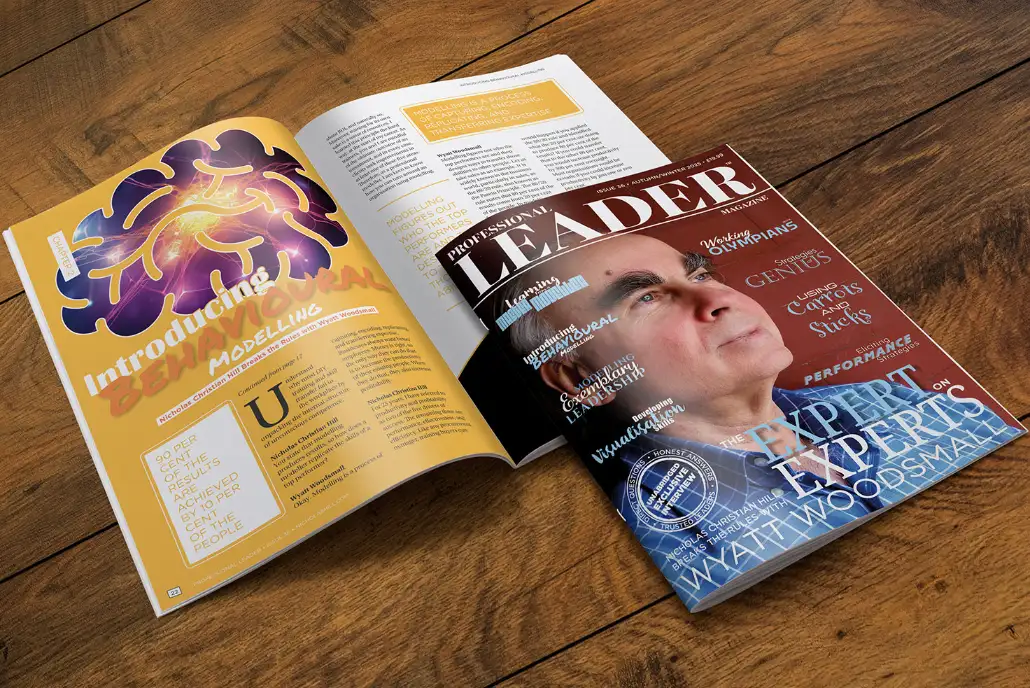
Introducing Behavioural Modelling

Chapter Overview

Six Pages

Understand why most DIY training and skill transfer fail in the workplace by unpacking the internal structure of unconscious competence.

Nicholas Christian Hill

You state that modelling produces results, so how does a modeller replicate the skills of a top performer?

Wyatt Woodsmall

Okay. Modelling is a process of capturing, encoding, replicating, and transferring expertise. Businesses always want better employees. Money is tight, so the only way they can do that is to increase the productivity of their existing people. When they do that, they also increase profitability.

Nicholas Christian Hill

For 25 years, I have referred to productivity and profitability as two of the five drivers of success. The remaining three are performance, effectiveness, and efficiency. Like any procurement manager, training buyers care about ROI, and naturally so. Moreover, training for its own sake is a waste of resources. I learned this principle the hard way, at the start of my career. As trainers, you and I are mindful of the ultimate outcome of an investment, and in every case, clients seek improvements in at least one of these five areas. Therefore, as a professional modeller, I am keen to know how you can turn around an organisation using modelling.

Wyatt Woodsmall

Modelling figures out who the top performers are and then designs ways to transfer those abilities to other people. Let us take sales as an example. It is widely known in the business world, particularly in sales, as the 80/20 rule, also known as the Pareto Principle. The 80/20 rule states that 80 per cent of the results come from 20 per cent of the people. In modelling, we frequently find that 90 per cent of the results are achieved by 10 per cent of the people. That is a frightening statistic. That means you could theoretically lay off 90 per cent and see only a 10 per cent decrease in productivity. However, what would happen if you applied the 80/20 rule and identified what the 20 per cent are doing to produce 80 per cent of the results? If you could transfer that to the other 80 per cent, you would increase productivity by 300 per cent overnight. Most organisations would be ecstatic if you could increase productivity by just one or two per cent.

Nicholas Christian Hill

I agree. Some managers view leadership and management development as abstract and theoretical. At the beginning of my career, I used to be defensive about many of these models. Today, I welcome debate in my courses because it is an opportunity for me to learn and grow. This is why my training style has evolved into a strategic group facilitation approach over the years, in which we adapt many of the models to enhance practicality. Research in organisational psychology indicates that leadership success is more closely linked to behavioural change and decision-making in real-world scenarios than to formal education. However, education remains the very foundation on which we leaders stand. So, I am curious, Wyatt. How do we make behavioural modelling more than just an academic exercise?


Wyatt Woodsmall

Most training is based on someone’s theory of what works. Modelling training is based on what successful people in that organisation are actually doing. Modelling is a way to make training much more productive and profitable. Training is expensive because you not only have to pay for it, but you also lose productivity while people are undergoing training. So modelling is the front end of what successful people actually do: transferring those capabilities rather than relying on someone’s theory about what works, which is usually only partially correct.

Nicholas Christian Hill

Okay. As we have discussed, a modeller is only concerned with an organisation’s top performers, and, from your experience, those top performers account for about 10 per cent of the workforce. As a student of yours, I already support modelling; however, I would like to play devil’s advocate as a voice for our readers. What if you just took the top 10 per cent and had them teach the other 90 per cent what they are doing, as many organisations instinctively attempt to do? Would they be able to do that?

Wyatt Woodsmall

No, they would not, for this reason: people operate out of unconscious competence. Experts do not know how they do what they do. The proof is simple: if they knew what they were doing and could transfer those abilities, the people they train would be as good as they are. However, that is rarely the case.

Nicholas Christian Hill

I agree and would like to expand on this point, if I may. Whenever somebody develops a skill set, they go through four separate developmental stages, defined as 1) unconscious incompetence, 2) conscious incompetence, 3) conscious competence, and then 4) unconscious competence. As you state, successful people operate out of stage four. Indeed, experts will operate beyond stage four. For instance, author Joseph O’Connor posits a stage five: mastery. Please explain how you elicit the structure of unconscious competence.

Wyatt Woodsmall

Absolutely. Modelling unpacks unconscious competence. The best compliment that we are given after a modelling project is to be told, ‘You have a far better understanding of how I do what I do than I do.’ When Marilyne and I worked with the US Olympic Team, the divers said, ‘The US diving team has been bringing people in, particularly psychologists, for years to talk to us, and you are the first people that actually understand what we do, speak our language, and can give a better explanation of what we do than we can ourselves.’ It is not effective to expect the top 10 per cent to train the others, because they do not know how they do what they do.

Nicholas Christian Hill

To better understand this discipline, we need to break down the components of modelling. What you are describing runs counter to how most organisations still approach learning. There is a long-held assumption that expertise can simply be explained, documented, and handed over, but decades of skill-development research suggest otherwise. The Dreyfus model, for example, shows that experts rely primarily on pattern recognition rather than on conscious rule-following. That makes them impressive performers, but often poor teachers of their own craft. When leaders ask their top performers to mentor others, they are frequently disappointed with the results. Frankly, I am not overly concerned because it keeps me in a job! What I want to explore with you is strategy elicitation, which involves uncovering the unconscious cognitive and behavioural strategies that are invisible to the performer and turning them into a structure that others can learn. With that objective in mind, how would you break down the components of modelling?

Wyatt Woodsmall

Sure. As we have discussed, modelling is a process of capturing, encoding, replicating, and transferring expertise. This transfer is a key part of the process. I have spent 30 years modelling training delivery. In general, most training out there is lousy. We have some powerful models, as you know, because you learned some of them in your trainers’ training with me. People who are content experts do not necessarily know anything at all about training. Therefore, we combine expertise in eliciting unconscious competence, designing a training programme, and delivering it to transfer expertise. In short, that is why experts cannot transfer their abilities directly to others.

Wyatt Woodsmall Interview Chapter 3

Conversation Focus

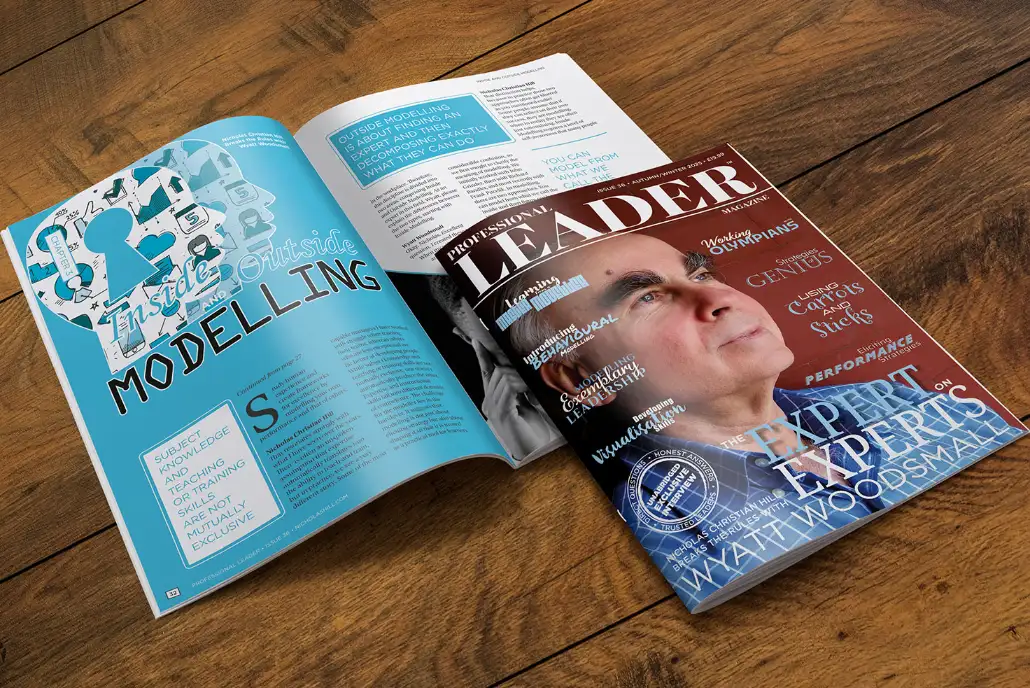
Inside and Outside Modelling

Chapter Overview

Six Pages

Study human experience and create frameworks for excellence by modelling your own performance and that of others.

Nicholas Christian Hill

That resonates strongly with what I have seen over the years. There is often an unspoken assumption that expertise automatically translates into the ability to teach and train, but in practice, we see a very different story. Some of the most capable managers I have worked with struggle when training their teams, whereas others who are less exceptional are far better at developing people. While subject knowledge and teaching or training skills are not mutually exclusive, one doesn’t automatically produce the other. Expertise and instructional skills fall into different domains of competence. The challenge for the modeller lies in the handover. It suggests that modelling is not just about eliciting strategy but also about shaping it so that it is treated as a practical tool for learners in the workplace. Therefore, this discipline is divided into two areas, comprising Inside and Outside Modelling. As an expert in this field, Wyatt, please explain the differences between the two types, starting with Inside Modelling.

Wyatt Woodsmall

Okay, Nicholas. Excellent question. I created these terms. When my wife, Marilyne, and I started, there was very little written on modelling. There was considerable confusion, so we first sought to clarify the meaning of modelling. We initially worked with John Grinder, then with Richard Bandler, and most recently with Frank Pucelik. In modelling, there are two approaches. You can model from what we call the inside and then figure out how you do what you do. Therefore, you are modelling yourself. However, you must be able to reproduce your results. Outside Modelling is about finding an expert and then decomposing exactly what they can do, but you may never be able to do it yourself. In fact, most of my work is Outside Modelling.

Nicholas Christian Hill

That distinction helps, because in practice those two approaches often get blurred as you mentioned earlier. Some people assume that if they can reflect on their own success, they are modelling, when in reality they are often just rationalising. Inside Modelling requires a level of self-awareness that many people have not yet developed. Outside Modelling, by contrast, holds that excellence can be analysed and then replicated. From a leadership perspective, that idea seems more realistic because managers need to understand how a top performer does what they do so they can reproduce those results across the rest of the team. Tell us about some of the work you did with Olympic athletes.

Wyatt Woodsmall

My wife, Marilyne, and I modelled the US Olympic divers, including people like Greg Louganis. There is no way in the world that I am going to get on the diving board, jump off, and do a ‘three-and-a-half’ somersault dive. Therefore, we do Outside Modelling with these athletes. John Grinder is a champion of Inside Modelling, whereas in most of the business world, it is not required. However, you need to train others to do it. That is why I do Outside Modelling. Others have proposed names. Robert Dilts called this implicit and explicit modelling. There is a deeper basis to it, and I only became aware of it about ten years ago.

Nicholas Christian Hill

That example makes the distinction very tangible. Leaders are rarely expected to replicate the technical brilliance of their top performers, just as you are not expected to throw yourself off a diving board! However, a leader must understand what enables that level of performance and then create conditions that enable others to reproduce it. I have seen managers model star performers, only to fail dramatically because they didn’t know how to elicit the internal strategy. The real leverage lies in the ability to decode patterns and then adapt them to suit the learner. Please share with us the ‘deeper basis’ of modelling.

Wyatt Woodsmall

One of my mentors is a gentleman named Ken Wilber, who is probably one of the smartest people on the planet. In his work, he uses the title ‘Integral Methodological Pluralism’. He says that when you study anything, you study it from eight different methodological perspectives. He has four quadrants, with access from top to bottom that moves from the individual to the collective. Then there is access from left to right, which goes from the inside to the outside. In modelling human beings, we examine what is occurring within the individual. There are two approaches, or methodologies, for studying human experience. One is phenomenology, the other structuralism.

Nicholas Christian Hill

Those terms will appear abstract for most people, so we must be pragmatic. I often hear managers talk about experience on the one hand and theory on the other. Sometimes we focus on how something feels from the inside, and at other times we try to break it down into components that can be understood and taught. Both approaches lead to very different conclusions; please explain the difference between phenomenology and structuralism.

Wyatt Woodsmall

Phenomenology explores the person’s experience in any activity, such as meditation. It focuses on the internal experiences, so this would be Inside Modelling. Structuralism, on the other hand, focuses on the structures underlying that experience and proposes a way to decompose what is going on.

Nicholas Christian Hill

Okay. Let’s review what we have discussed so far. Using your words, modelling is capturing, encoding, replicating, and transferring expertise. Inside Modelling involves modelling yourself. Therefore, you need to become consciously aware of your own internal processes (cognition), internal states (emotions, attention, and consciousness), and external behaviour (visible physical movement). The method of Inside Modelling involves replicating everything functional in your unconsciousness for each of these three areas, so that you can teach other people your strategies. Outside Modelling, on the other hand, is concerned with capturing, encoding, replicating, and transferring someone else’s expertise so that you can utilise their strategies yourself or teach them to others. The modeller’s task, in this context, is to help the person become conscious of their internal processes, internal states, and external behaviour so that the modeller can document them strategically. Am I right?

Wyatt Woodsmall

Yes, that is a good summary. Now, phenomenology will never give you structuralism, and structuralism will never give you phenomenology. You can meditate forever, but you will never directly encounter the structures. You can encounter the structures, but you may never be able to meditate. Much of the confusion on these subjects stems from people pursuing different forms of structuralism. In other words, they have various ways of decomposing from the outside what is going on. They operate from different models. The models my wife, Marilyne, and I usually use are based on Neuro-Linguistic Programming and cover representational systems, physiology, emotions, and strategies. The phenomenological approach is what John Grinder uses. Then there is the structural approach, which I use. Both methods are valid. Furthermore, both will give you different information.

Nicholas Christian Hill

Right. Some behavioural modellers often mix these approaches without realising it, whether in athletics, as with the examples you provided or in business. Some of my clients reflect deeply on their experience between delivering training workshops. They report back, believing they have uncovered the structure behind their achievements, when in reality they are only operating at the level of personal insight. Others jump straight into breaking behaviour down into parts without ever evaluating their internal experience. These activities remain valid because they deepen self-awareness, which is a precursor to improvement. However, they are inadequate if people want to replicate their success or build on it. I agree that both approaches offer value and answer different questions. What interests me is how modelling embraces both approaches and helps achieve the objective of transferring performance to another person rather than simply describing it.

Wyatt Woodsmall Interview Chapter 4

Conversation Focus

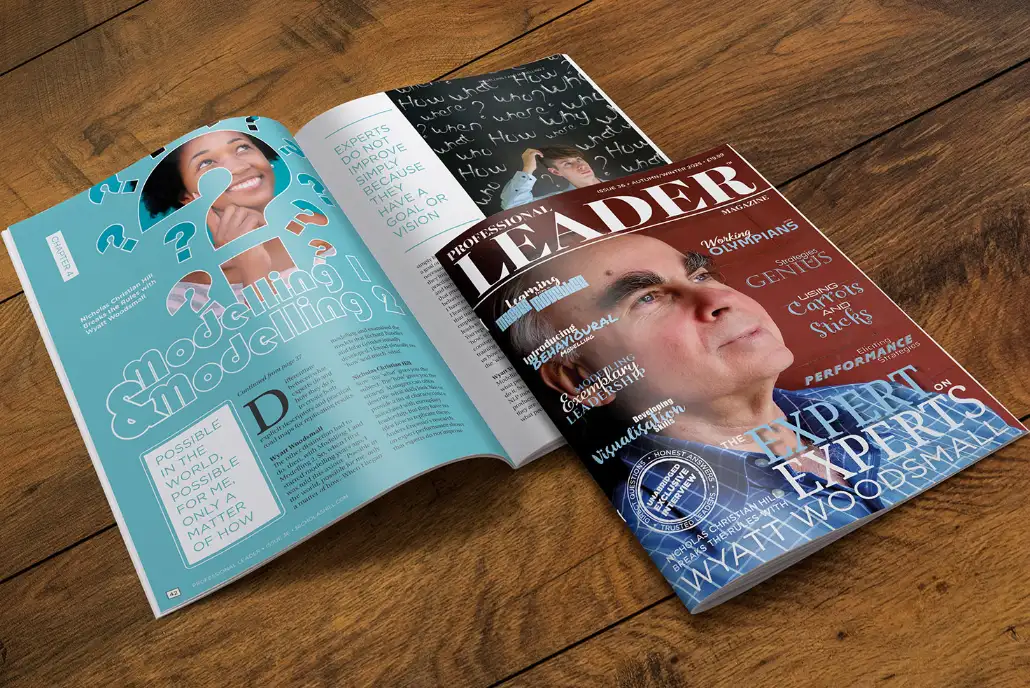
Modelling 1 and Modelling 2

Chapter Overview

Six Pages

Differentiate between what experts do and how they do it to create both explicit descriptors and practical road maps for replicating results.

Wyatt Woodsmall

The other distinction had to do, then, with Modelling 1 and Modelling 2. So, when I first started modelling years ago, I was told this axiom, ‘Possible in the world, possible for me, only a matter of how.’ When I began modelling and examined the models that Richard Bandler and John Grinder initially developed, I found virtually no ‘how’ and much ‘what’.

Nicholas Christian Hill

Sure. The ‘what’ gives you the subject. The ‘how’ gives you the strategy. Managers can often describe what skills look like or provide a list of characteristics associated with exemplary leadership, but they have no idea how to replicate them. Anders Ericsson’s research on expert performance shows that experts do not improve simply because they have a goal or vision. This is still necessary, of course. But they improve by repeatedly practising the specific cognitive and behavioural processes that produce the result. This is behavioural conditioning, which I have endorsed for decades. I learned early in my career that training, when it primarily emphasises the ‘what’, seldom leads to behaviour change. You report finding very little ‘how’, which aligns with what I consistently observe in others’ training delivery. So, please tell us how modelling elicits both the ‘what’ and the ‘how’.

Wyatt Woodsmall

Modelling 1 is simply capturing what people do, not how they do it. So, if you look at the NLP models that have been produced, in most cases, they are all ‘what’. It tells you what people do and what is important. We need to start with the ‘what’. Modelling 2, which I am interested in, figures out how people do the ‘what’. Part of the ‘how’ includes strategies. It is interesting that, in NLP, we are never given any strategy used by Fritz Perls, Virginia Satir, Milton Erickson, or Gregory Bateson, whom Grinder and Bandler originally modelled. We got the ‘what’ but never got the ‘how’. Modelling 2 is about the ‘how’. Michael Hall has adopted this distinction I proposed, in which he discusses Modelling 1 and Modelling 2. That is the difference between the two. Most modellers are essentially doing Modelling 1. They are figuring out what people do. Very few people are undertaking Modelling 2. Modelling 2 involves understanding ‘how’ people do what they do and designing ways to transfer those abilities to others.

Nicholas Christian Hill

Right. Let us take time out to review this again, please. By executing Modelling 1, you capture a detailed analysis of what successful people do, insofar as it describes the goal, plan, and realised outcome. Modelling 2 is an instruction manual for implementing the concepts described in Modelling 1. Furthermore, only after you have completed Modelling 2 are you in a better position to teach others how to replicate the success of the top 10 per cent. Modelling 1 is often what’s missing in organisations. I frequently find a lack of vision and goals, or, if they are present, they are vague, so we would work hard to develop these areas. However, without Modelling 2, people eventually know what excellence looks like but lack the means to achieve it. So, the distinction you are making is not academic. It explains why so much leadership and management training sounds impressive yet fails to change behaviour once people return to the workplace.

Wyatt Woodsmall

Exactly! This is the universal problem of training. Why don’t people do what they are trained to do? Why does training not work? Training does not work because people are taught what to do, even though they already know what to do. So why are they not doing it? They are not doing it because they do not know how, or because something within them is blocking them from doing it. Real modelling, or Modelling 2, involves figuring out how people do it and transferring the ‘how’. That is where the focus should be, and it will help improve performance. Simply telling people what to do is insufficient. You have to train people how to do it.

Nicholas Christian Hill

Sure. I recall you teaching this subject to us in 2006, during my trainers’ training. It is for this very reason that I have spent thousands of hours developing tools on our own training courses, which place a high emphasis on the ‘how’ without neglecting the ‘what’. This distinction between the ‘what’ and the ‘how’ is also pertinent outside the business world. Both of us studied at seminary for a period. I spent four years at Spurgeon’s College in London. During that time, I researched hermeneutics, the study of interpretation. What I noticed from most of the trainings, teachings, sermons, and lectures that I have listened to in my lifetime is that the speaker, quite often, discusses only the ‘why’ or the ‘what’. Seldom will they discuss the ‘how’. My research on leadership and management development highlights the importance of focusing more on the ‘how’. What is your reflection on the application of the ‘how’ outside the business world?

Wyatt Woodsmall

I would agree, totally. Hermeneutics is a methodology for studying the inside of the collective. Hermeneutics is applied to interpret the Bible or other texts. Many ministers preach until they are blue in the face and do not get results from the congregation because they tell them what to do or why to do it, as you said, but do not tell people how to do it. The real focus needs to be on the ‘how’, and when we can do that, we make a significant difference in performance. Nevertheless, as long as we are chasing the ‘what’, we cannot do that.

Nicholas Christian Hill

Hermeneutics aside, before we can perform Modelling 1 or 2, we must complete Inside or Outside Modelling, depending on the objective. Therefore, the modeller needs to be sufficiently skilled to elicit unconscious processes, either their own when applying Inside Modelling, or those of the subject when applying Outside Modelling.

Wyatt Woodsmall

Yes, that is a good summary.

Wyatt Woodsmall Interview Chapter 5

Conversation Focus

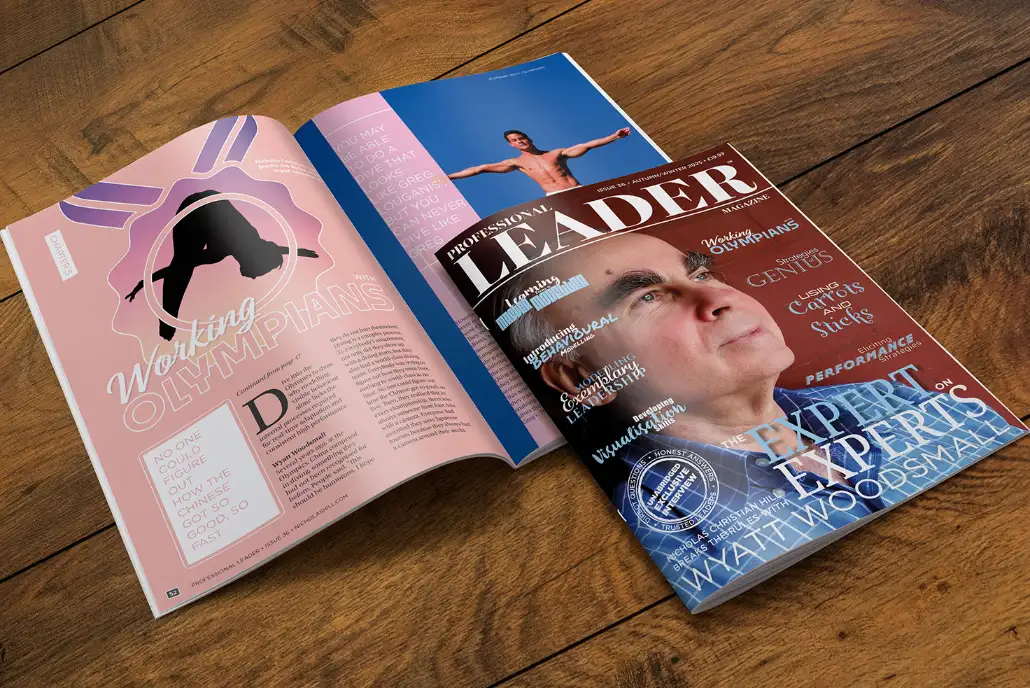
Working With Olympians

Chapter Overview

Six Pages

Dive into the Olympics to show why modelling visible behaviour alone lacks the internal processes required for real-time adaptation and consistent high performance.

Wyatt Woodsmall

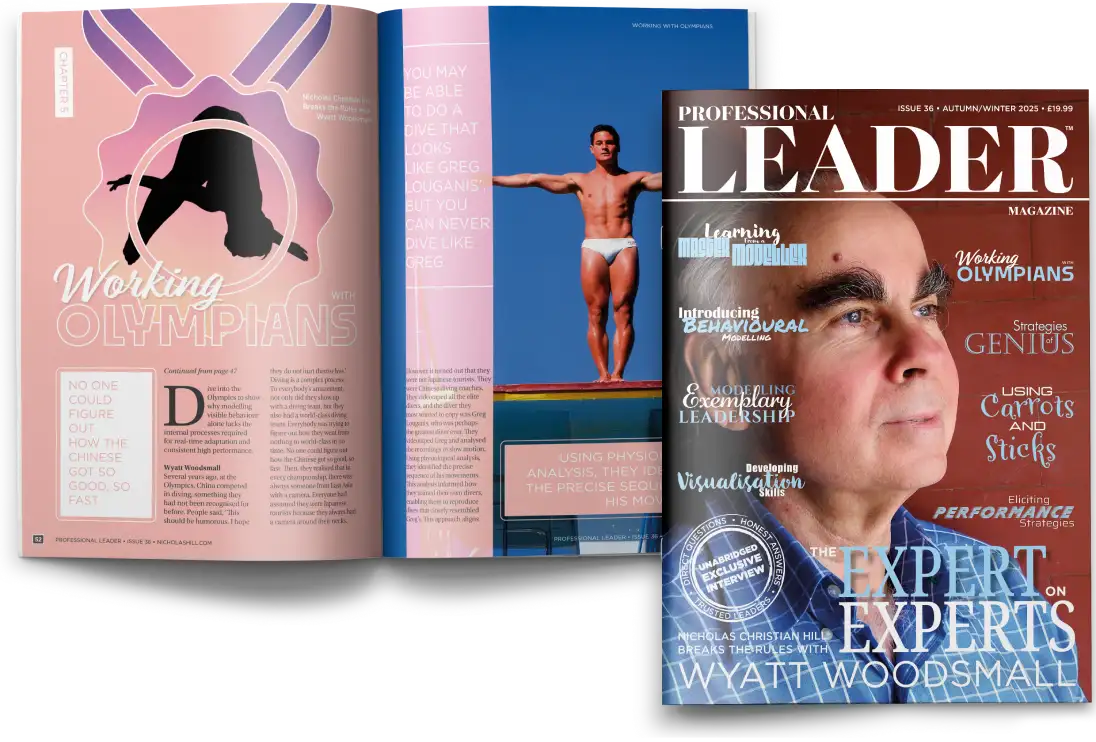
Several years ago, at the Olympics, China competed in diving, something they had not been recognised for before. People said, ‘This should be humorous. I hope they do not hurt themselves.’ Diving is a complex process. To everybody’s amazement, not only did they show up with a diving team, but they also had a world-class diving team. Everybody was trying to figure out how they went from nothing to world-class in no time. No one could figure out how the Chinese got so good, so fast. Then, they realised that in every championship, there was always someone from East Asia with a camera. Everyone had assumed they were Japanese tourists because they always had a camera around their necks. However, it turned out that they were not Japanese tourists. They were Chinese diving coaches. They videotaped all the elite divers, and the diver they most wanted to copy was Greg Louganis, who was perhaps the greatest diver ever. They videotaped Greg and analysed the recordings in slow motion. Using physiological analysis, they identified the precise sequence of his movements. This analysis informed how they trained their own divers, enabling them to reproduce dives that closely resembled Greg’s. This approach aligns with John Grinder’s modelling. Now, in copying physiology, you may be able to do a dive that looks like Greg Louganis’, but you can never dive like Greg because you do not have Greg’s internal processes.

Nicholas Christian Hill

This is an interesting point, which many behavioural modellers neglect. The elicitation of unconscious internal processes, as we just confirmed, is an essential part of modelling and helps us to figure out the ‘how’, the objective of Modelling 2. Your story highlights the problem with replicating performance. To an observer, the dive appears correct, so they copy the diver’s actions through visual replication. Yet what the diver did inside his mind and body to achieve the result is overlooked. In business, I see the same pattern. Years ago, I observed managers copying behaviours, scripts, or routines from top performers, only to be surprised when they couldn’t replicate the results. I heard managers say, ‘The tool doesn’t work!’ Wyatt, what were some of Greg’s internal processes that you were able to record after working with him?

Wyatt Woodsmall

Greg had this great quote. He says, ‘In diving, there is a sweet spot on the board, right at the end. Sometimes, I am a little over. Sometimes, I am a little under. I do not know until I am in the air. Judges do not know either. I cannot leave my mind on the board. I must stay in the dive. That is why I train so hard. I must be able to get there and deal with whatever takeoff I have been given. Sometimes I must get there from all the wrong places.’ Greg is a total ‘Difference’ person. The Chinese diving team were ‘Sameness-oriented’. If they hit the sweet spot, they know how to dive like Greg. However, if they do not hit the sweet spot, they do not know how to compensate. Greg, being a total ‘Difference’ person, must wait until he is in the air. He then determines his position, knows where to go, and makes the in-flight corrections needed to arrive at the correct destination, but sometimes he starts from the wrong place.

Nicholas Christian Hill

And that understanding is what the Chinese team overlooked. I want to clarify what you said about ‘Sameness’ and ‘Difference’. These are Meta Programs, which can be assessed psychometrically. ‘Sameness’ refers to the notion that some people are inclined towards familiarity, and this is how they filter experience. For a sameness-oriented person, strategies, people, places, and foods must have content like that of previous experiences. In contrast, ‘Difference’ refers to the notion that some people are inclined towards unfamiliarity and, again, filter experience in this way. Perceptual patterning research reveals that these Meta Programs operate at an unconscious level, so a person will be unaware of these filters yet influenced by them and feel unable to control their response to them! We teach that ‘Sameness’ supports consistency and repeatability. ‘Difference’ supports adaptation and correction. Both filters operate differently according to changing conditions. We accept that neither orientation is inherently superior. Each has its own advantages and disadvantages. Wyatt, how would you simplify these patterns for someone new to these ideas?

Wyatt Woodsmall

‘Sameness’ refers to people who want to do things the same way every time, whereas ‘Difference’ refers to people who do it differently every time.

Nicholas Christian Hill

Right. ‘Difference’ being Greg, and ‘Sameness’ being the Chinese divers. So, are you saying, therefore, that Greg had the predilection to step out and dive differently if it was necessary? Whereas the Chinese divers would dive the same way, even when circumstances demanded otherwise.

Wyatt Woodsmall

Yes. That is precisely what I am saying.

Nicholas Christian Hill

What you describe in diving aligns with research in other sports. Studies of athletic performance indicate that cognitive processes are as important as technical skills. Anders Ericsson’s ‘expert performance approach’ explains how elite athletes outperform others in cognitive tasks such as pattern recognition. This helps us understand why simply copying a sequence of moves can look correct yet fail to deliver the same results. Peak performance depends on noticing key cues and adapting in real time. I am an amateur bodybuilder. I train daily, but I am a million miles from being a professional athlete. That said, whether we are aiming for success in our pastimes or professions, we need more than an outward display of physical exercise. Psychological factors play a significant role and contribute to mental and emotional rehearsal. Similarly, this research shows that in business, when teams mimic peak performance without understanding the core internal processes, they fall short.

Wyatt Woodsmall Interview Chapter 6

Conversation Focus

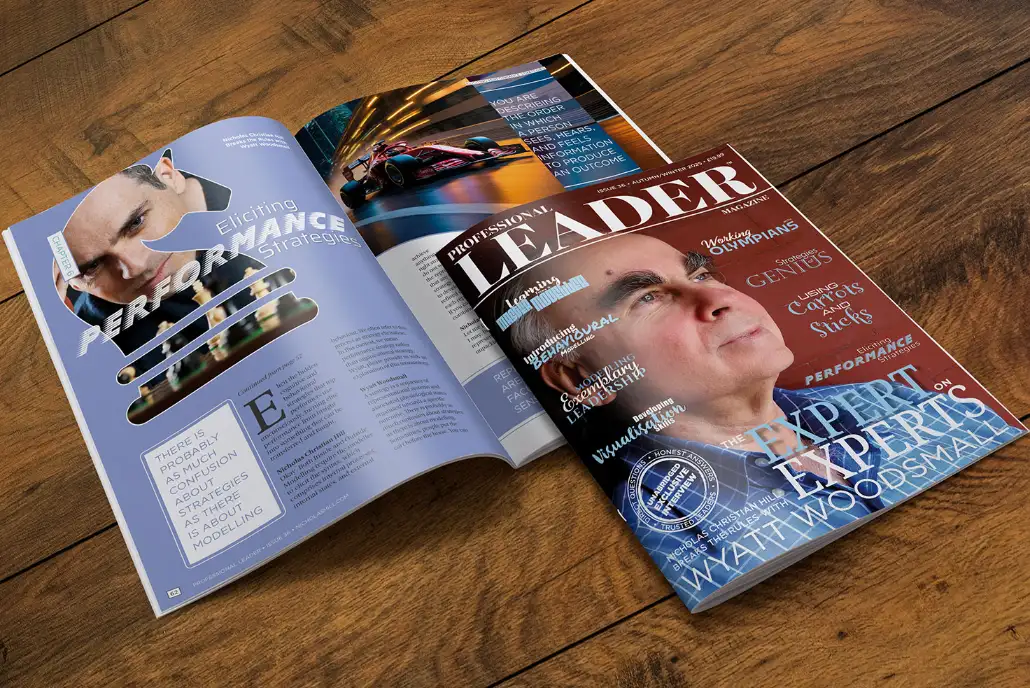
Eliciting Performance Strategies

Chapter Overview

Six Pages

Establish why behavioural modelling is a credible way to replicate excellence by studying experts and understanding how they achieve results.

Nicholas Christian Hill

Okay. Both Inside and Outside Modelling require the modeller to elicit the syntax, which comprises internal processes, internal states, and external behaviour. We often refer to this process as strategy elicitation. In this context, we mean performance strategy rather than organisational strategy. Wyatt, please provide us with an explanation of this terminology.

Wyatt Woodsmall

A strategy is a sequence of representational systems and associated physiological states organised towards a specific outcome. There is probably as much confusion about strategies as there is about modelling. Sometimes, people put the cart before the horse. You can achieve anything with the right strategy. Strategies do not work unless you can use the representational systems that are sequenced in the strategy. The first skill you need to develop is the ability to make refined discriminations within each representational system. If you can do this, you can combine these into strategies.

Nicholas Christian Hill

Let me pause you there, if I may, because the term representational system needs unpacking if this is going to make sense to others. In simple terms, representational systems are the human sensory faculties that process sensory experience. We are talking about visual, auditory, kinaesthetic, and, to a lesser extent, olfactory and gustatory information. This name reminds us that human senses only represent the world. Our interpretation, therefore, is not reality. When someone thinks, decides, or acts, they rely on one or more of these systems internally. So, when you say a performance strategy is a sequence of representational systems, you are describing the order in which a person sees, hears, and feels information to produce an outcome. What is often overlooked in training is that people may understand the steps of the strategy but lack sufficient sensory acuity in practice. Wyatt, please provide an example of a simple strategy that we can all relate to.

Wyatt Woodsmall

Of course. The standard strategy you can use is the spelling strategy, in which you are asked to spell the word. You can look up and see an image of the word and then read it aloud. This is a poor example because it is the simplest case. It occurs in the shortest timeframe. Almost no strategies are that simple. Many strategies can be implemented over days, weeks, or even months, making them much more difficult to track. If it happens instantly, you can use the spelling strategy. That is an example of a strategy.

Nicholas Christian Hill

The spelling strategy is helpful because it shows the structure clearly. Another example I have used is driving a car. Someone might know how to reach a destination, but if they were to write down the strategy to get there, it would run into hundreds of pages. This is why learning to drive typically requires several lessons for most of us. The strategy would include how to respond mentally and physiologically to other vehicles, landmarks, pedestrians, and street names. It would consist of a kinaesthetic component, such as a sense of when to turn, apply the brakes, speed up, or slow down. That sequence may run automatically, out of unconscious competence, as we have discussed, but it remains a strategy grounded in representational systems.

Wyatt Woodsmall

Interestingly, Richard Bandler and John Grinder never tell us any strategy used by Milton Erickson, Fritz Perls, Virginia Satir, or Gregory Bateson. Strategies can be highly valuable, but some modellers often propose oversimplistic solutions. Developing a detailed action strategy requires greater sophistication than simply observing eye movements and listening for predicates.

Nicholas Christian Hill

Right. When performance strategies are oversimplified, it becomes harder to replicate the results. People like shortcuts, because it's the path of least resistance. However, with careful observation and understanding of pattern recognition, we can identify the behavioural strategies. Erickson worked almost entirely with context, timing, and responsiveness of the individual. Satir focused on patterns of relating and emotional congruence. Perls challenged people to notice experience as it unfolded. Bateson was concerned with systems and levels of learning. We would all have benefited from knowing the internal strategies used by these giants. Please elaborate on how professionals use performance strategies to achieve success.

Wyatt Woodsmall

Strategies can be compelling in modelling, but you will not necessarily go after them in all cases. To implement the strategies, you need to be able to use the representational systems. A great example is chess. Chess masters can play 20 to 30 simultaneous blindfold games, with the boards arranged in a circle or square around them. A person informs them of the last move, and then they make their move. What do they need to play blindfolded? They must remember two things: all the pieces on the board for twenty different boards. They must remember the positions of the pieces on each board and mentally reconstruct the consequences of moving them. They may be thinking five or ten moves ahead. They can work out all these combinations quickly in their heads.

Nicholas Christian Hill

Chess is a valuable illustration, Wyatt. Studies by Chase and Simon showed years ago that masters do not remember more pieces than novices. Rather, they are recognising patterns. They see configurations that mean something to them, which allows them to compress vast amounts of information into manageable chunks. Playing chess with closed eyes might be possible for experts, but beginners would prefer playing with eyes wide open! The audience sees an expert with infinite memory, but in reality they are seeing someone with refined perception. The same principle applies in the workplace. People assume exemplary leaders think faster or know more, when in reality they perceive differently. Their internal representation of the situation allows them to anticipate and evaluate options before taking appropriate action. Their direct reports are then either in awe or in reaction. Let’s get back to chess. What are some of the performance strategies that chess players use when playing blindfolded?

Wyatt Woodsmall

The chess master will be using the visual representational system, specifically Visual Remembered and Visual Construct. This is a frequent challenge because most people cannot reliably access or sustain these visual processes. A classic example, once again, is the spelling strategy. You are told to look up and see the word. When most people look up, they do not see the word; they see the ceiling. Training people to recognise the word may require time. Therefore, any strategy will only be effective if you can utilise the representational systems on which it depends. You may have to train people to do that, but it could take a lifetime.

Wyatt Woodsmall Interview Chapter 7

Conversation Focus

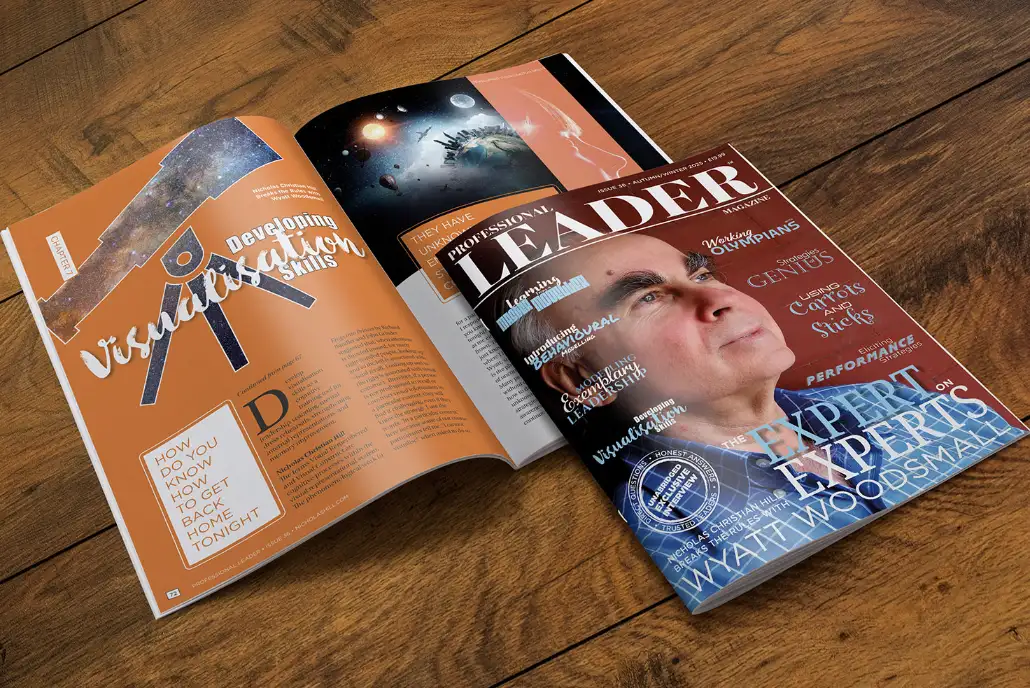
Developing Visualisation Skills

Chapter Overview

Six Pages

Develop visualisation skills as a cognitive training tool for leadership visioning, mental dress rehearsals, strengthening internal representations, and memory improvement.

Nicholas Christian Hill

The terms Visual Remembered and Visual Construct are cognitive processes within the visual representational system. The phenomenological work in Frogs into Princes by Richard Bandler and John Grinder suggested that, when attention is directed inward, for many right-handed people, looking up and to the left is associated with visual recall. Looking up and to the right is associated with visual construct. Therefore, if a person is not predisposed to recall or construct visual information in a particular context, they will find it challenging, even if they know the strategy. I use the words, ‘In a particular context,’ here because some of my course participants tell me, ‘I cannot visualise!’ when asked to do so for a particular exercise. Often, I respond with, ‘Then how do you know how to get back home tonight?’ Then they will look at me either blankly or with a frown. The reply might be, ‘I just know how to,’ or ‘I know where I live!’ As you mentioned, Wyatt, successful behaviour is the physical demonstration of unconscious competence. Many people perform a task well without consciously knowing how to do it, because they have unknowingly embedded the strategies outside conscious awareness. I would then continue my line of questions with something like, ‘As you exit this building, what will you see directly in front of you?’ After they have answered that question, I might also ask, ‘On your journey home, which will be the first set of traffic lights that you see?’ To respond to the questions, they have no choice but to access the information by looking upwards and internally, before giving me the answers. I might then ask the person to explain how they were able to provide those answers. Typical responses would be, ‘I could see it in my head.’ At that point, I smile and say, ‘So you thought you could not visualise!’ This process prompts the student to question whether they can apply the same strategy to a different context. That is all I need to begin the next step in developing their visualisation skills. Wyatt, please elaborate on the challenges you encounter in developing sensory performance.

Wyatt Woodsmall

Qualifying the axiom I used earlier, ‘Possible in the world, possible for me, only a matter of how,’ I would add, ‘How many years will it take to develop the required representational system ability?’ You cannot train people in the strategy until you can train them to make the necessary representational distinctions. It’s difficult because you have spent your entire life developing and practising the representational systems you are using. If you are going to get better, it may require a lifetime. These are some of the real-world challenges of modelling and, arguably, the greatest challenge of using strategies.

Nicholas Christian Hill

Just to reflect on what you have said for a moment, Wyatt, if we take a successful person who is kinaesthetically oriented, their strategy could be highly kinaesthetic, depending on the context, because preferences do vary according to environmental conditions. For instance, a person may be visually oriented at work but kinaesthetically oriented at home. If we now train someone who is visually oriented in a given context, that person will find it very difficult to adopt a predominantly kinaesthetic strategy, since it will conflict with their conditioned predilections.

Wyatt Woodsmall

You are absolutely correct. This is the whole key to the process. This is why one of the primary things we say is, ‘Pre-selection always buys you more than training.’ There is a notion that you can train anyone to do anything. That is nonsense. If they cannot make these distinctions within their representational systems, then you cannot train them, or it may take a lifetime. Therefore, you need to pre-select people. If you want to train people to become chess grandmasters, you had better start with people who are highly visual and can engage in Visual Construct. If you start with anything else, that will not work.

Nicholas Christian Hill

Yes. Given differing sensory preferences, a person may have a strategy but be unable to adopt it naturally. This notion has clear implications for recruitment. Some organisations hire based on experience or attitude, then expect training to do the heavy lifting. What is frequently overlooked is whether the person can process information in a manner the role demands. I have seen capable people struggle not through lack of desire or effort, but because the job imposed demands that conflicted with their cognitive biases or conditioning. This does not mean they cannot be trained. It simply means the incline is much steeper.

Wyatt Woodsmall

Yes. In fact, relatively few people will be able to adopt that strategy naturally and will need training.

Nicholas Christian Hill

What you describe aligns with research in sports psychology on the power of mental imagery. These studies consistently show that athletes across a range of sports who engage in structured visualisation improve performance, including movement coordination, confidence, and stress regulation. Visualisation techniques also help athletes form a ‘mental blueprint’ of movements, making physical execution more fluid. I once had the privilege of writing alongside Kriss Akabusi, who publicly endorses these principles. Outside the sporting arena, business philosophers such as the late Jim Rohn advocated visualisation as a significant contributor to goal achievement. This is because visualisation can strengthen neural pathways associated with motor function, thereby affecting performance. Other research has shown that visualisation can reduce anxiety and build resilience. However, without physical engagement, visualisation remains isolated. For this reason, when appropriate, I use guided visualisation exercises with managers to help them create a future to which all team members want to belong. In the past, some resisted and dismissed the idea as airy-fairy! I now frame visualisation in terms of evidence of its effectiveness.

Wyatt Woodsmall Interview Chapter 8

Conversation Focus

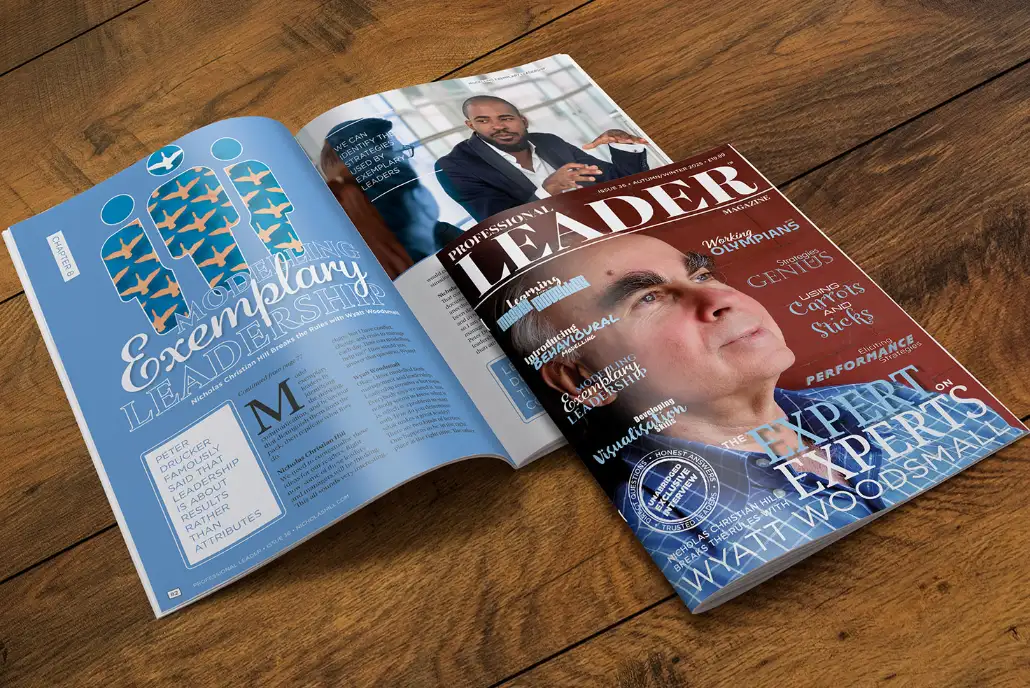
Modelling Exemplary Leadership

Chapter Overview

Six Pages

Model exemplary leaders by identifying the thinking, communication, and behaviour that distinguish them from the pack, then replicate what they do.

Nicholas Christian Hill

We need to contextualise these ideas for our readers. Right now, some of these leaders and managers will be thinking, ‘This all sounds very interesting, chaps, but I have conflict, change, and crisis to manage each day. How can modelling help me?’ How would you answer that question, Wyatt?

Wyatt Woodsmall

Okay. I have modelled both management and leadership. Leadership remains a hot topic. Everybody says we need it, but nobody seems to know what it is, which is a problem to start with. How do you determine what makes a great leader? There are two kinds of heroes. One happens to be in the right place at the right time. The other would come out on top in any situation.

Nicholas Christian Hill

That confusion is well documented, and it is not just anecdotal. Leadership has been defined numerous times and in many conflicting ways, so I am never surprised when managers express confusion. Peter Drucker famously said that leadership is about results rather than attributes, suggesting that effectiveness defines the leader. Warren Bennis argued that leadership is about vision and the ability to make that vision into reality. John Kotter characterised leadership as the process of coping with change and management as the process of coping with complexity. Then you have Henry Mintzberg pushing back against heroic models altogether, arguing that leadership is embedded in roles, relationships, and context rather than individual charisma. By applying modelling to leadership, we can identify the strategies used by exemplary leaders and learn how to replicate them. Please tell us how you do this, Wyatt.

Wyatt Woodsmall

In modelling leadership, my wife, Marilyne, and I find people who are great leaders, and then work with them to figure out how they do what they do. Part of the work is conducted in isolation, and part is in the operational context. What are the circumstances in which they can be a great leader? Would they be able to be a great leader in other circumstances? What strategies are they using to do that? Managing is quite different from leadership. Leadership is the process of figuring out what the ideal future is, designing a pathway to that future, and then inspiring people to get there.

Nicholas Christian Hill

Right. I developed a definition in 2008 for our ILM courses to clarify the distinction between leadership and management. And it is this: management is concerned with applying systems and processes. Leadership is concerned with empowering the people who utilise systems and processes to ensure successful application. I haven’t altered this definition in nearly 20 years. Most clients immediately resonate with the distinction when I share it. Certainly, vision is a critical component of leadership. As we read in Proverbs 29:18, ‘Where there is no vision, the people perish.’ What would you say are the vital components of visioning?

Wyatt Woodsmall

In leadership literature, the word ‘vision’ continually emerges, but what is a vision? A vision is a picture. Leaders have a vision, a vision of a better place, a vision of a better world. They can communicate that vision, thereby eliciting a kinaesthetic response. They can bond with followers’ emotions, making them ready to follow and to go where they are being led.

Nicholas Christian Hill

As you know, Robert Dilts has published work on visionary leadership. Dilts argues that vision is processed at a higher cognitive level than behaviour or strategy, meaning it drives every lower-level process. It is concerned with creating a compelling picture of the future that aligns identity, beliefs, and action. In his view, effective leaders translate vision into something people can both feel and understand. When that happens, commitment becomes a natural response. People then act because the vision makes sense to them practically and drives them emotionally. From your experience, what components are often missing from visionary leadership?

Wyatt Woodsmall

Subskills are required. One: You must be able to develop a vision. Two: You must be able to articulate the vision. Three: You must be able to communicate it and elicit an emotional response. This third skill concerns understanding how to motivate people. These are some examples of leadership. So, what is the leader’s vision? Can they communicate it in a way that makes anyone excited? Will anyone want to follow them? Once you can articulate your vision, how can you present it to create an emotional impact on others?

Nicholas Christian Hill

Absolutely. I worked with thousands of leaders and managers over three decades. For the past 10 years, this has primarily involved senior or strategic-level personnel. On the subject of motivation, clients often want to know how to get their teams as excited as they are about the vision. They hope for a quick fix, but it is rarely possible without a foundational understanding of human motivation. Therefore, I might share various motivation theories and techniques. Depending on their requirements, this might include ideas on motivational drivers, human needs psychology, psychometrics, body language, and advanced communication models. Given your expertise in modelling, Wyatt, how do successful leaders present the vision to elicit an emotional response?

Wyatt Woodsmall

One of the patterns that you are familiar with, Nicholas, is Meta Programs. Marilyne and I call them people patterns, and we describe them in our book, called People Patterns, which discusses ‘towards’ and ‘away-from’ orientation. Leaders have a vision they are moving towards, and they try to get people to move towards it, whereas half the world moves away from something. That means they do not necessarily do things to get something; they do them to avoid something.

Nicholas Christian Hill

Psychologists were studying approach and avoidance motivation long before Meta Programs were given that label. Kurt Lewin posited that people organise action either by moving towards desired outcomes or by avoiding negative ones. Subsequent research in motivational psychology has reinforced this, demonstrating that some individuals are energised by gains, whereas others are more driven by loss avoidance. I continue to teach these principles and have seen projects that were once slowed by a lack of impetus now accelerate. What matters is not which orientation is better, but whether the leader recognises the difference. If a leader frames a vision only as something to move towards, half their audience is left uninspired.

Wyatt Woodsmall

Leaders try to get everyone to share their enthusiasm and excitement, but then wonder why it isn’t working. The reason is that more than half of the people in the organisation will not move until conditions worsen. The leader cannot just talk about the glory of heaven. They have to talk about hell, which is where you are already at, and they have to describe it in such a way that people go ‘Whoa! I don’t want to be here, and I am willing to do something to get out of here.’ This is motivation, which involves ‘towards’ and ‘away-from’ orientation. Many leaders are positive and only see the ‘towards’ and do not understand the ‘away-from’. They are unable to use it effectively, which is why they tell you exactly what they told you: ‘I have got the vision, but I cannot get people inspired.’

Wyatt Woodsmall Interview Chapter 9

Conversation Focus

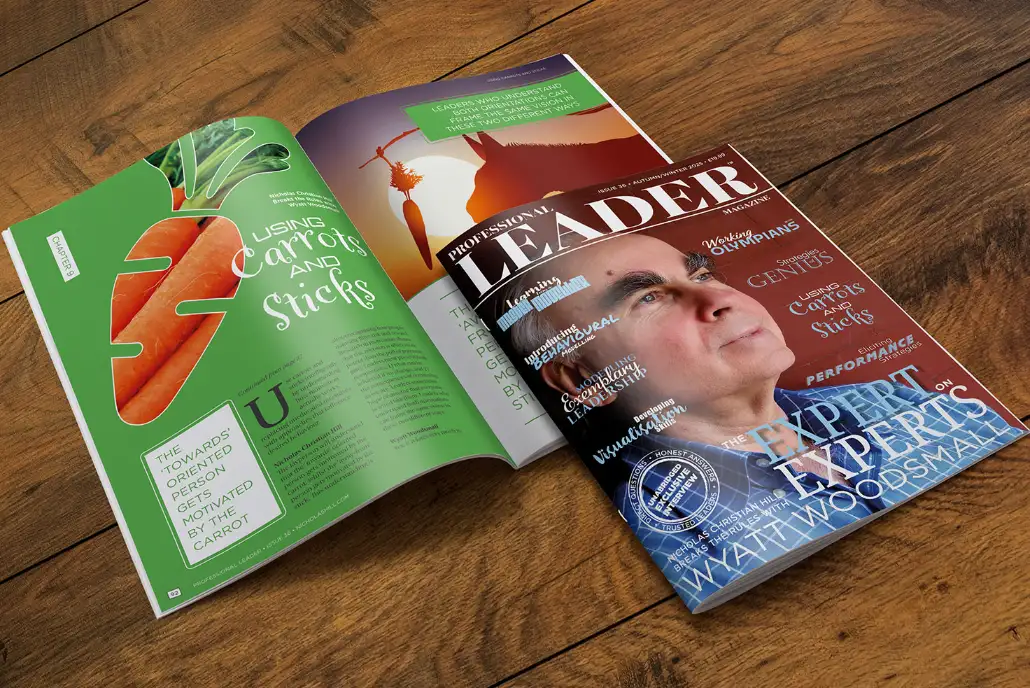
Using Carrots and Sticks

Chapter Overview

Six Pages

Use carrots and sticks intelligently by understanding how motivation actually works, replacing uneducated incentives with approaches that influence desired behaviour.

Nicholas Christian Hill

The layperson will understand that the ‘towards’ oriented person gets motivated by the carrot, whilst the ‘away-from’ person gets motivated by the stick. This understanding is about recognising how people naturally filter risk and reward. Research in motivation shows that risk aversion is often more potent than the pull of potential gain. Leaders must present both perspectives: 1) what can be achieved if we change, and 2) the consequences of remaining as we are. Leaders sometimes hope or assume that everyone is wired like them. Leaders who understand both orientations can frame the same vision in these two different ways.

Wyatt Woodsmall

Yes, it relates very much to leadership. As you noted, the understanding of motivation has long existed. It is the science of carrots and sticks. Certain people respond to carrots, and you have to bribe them. Specific individuals react to sticks, and you must punish them. Every parent needs to know how to get their kids to clean their rooms. Not all are the same. Some of them, you have to bribe. Others, you must punish them if they do not clean their room.

Nicholas Christian Hill

Okay. May I note your comment about the need to bribe people who are ‘towards’ oriented? Because we have worked together, I know you are not referring to ‘bribe’ in the literal sense. Instead, you are applying an extrinsic incentive in this example and polarising the language. Some managers I train talk about using an ethical bribe with their team members. However, this is a misnomer. A reward is payment for expended resources, whereas a bribe is payment for unethical conduct. My definition is that a reward is receiving recompense for doing something you would not usually want to do. Accepting a bribe, by contrast, means receiving recompense for doing something you should not do. The former is perfectly acceptable as a means to get people to do what you want, whilst the latter has profound ethical implications. Referring back to my 2006 trainer training, you introduced the 4MAT model, used by teachers and trainers alike to present a concept and achieve a positive reception. I continue to use it for all training delivery and even teach in my presentation skills courses. This process begins by sharing the ‘why’ component with the audience to motivate them to listen, engage, and participate in the ongoing discussion. One technique you shared with us that I found particularly profound belongs to the ‘why’ and is what you refer to as the six sermons. Please share a brief overview of this concept, as it builds on the carrot-and-stick model.

Wyatt Woodsmall

Carrots and sticks have been around a long time, but not all carrots and sticks are the same. As a shorthand model of this, David McClelland, who is probably the leading expert in the world on motivation, says that people operate in one out of three of what he calls ‘fundamental motives’. These are power, affiliation, and achievement. As a leader, you must be able to reach people motivated by power, affiliation, or achievement.

Nicholas Christian Hill

Right. I became fascinated by his work after working with you. McClelland gives us a practical perspective on motivation. His research into Need for Achievement theory showed that people are motivated by different rewards, even when they share the same role. What matters here is that motivation is learned and reinforced over time. It is not hardwired as with personality. When leaders frame a vision around a single motive, they disengage other team members. Therefore, leaders must adapt how they present the vision. Please help us continue contextualising McClelland’s work on leadership.

Wyatt Woodsmall

There are, then, three types of leaders. The power leader is the boss. The achievement leader is the manager, whose job is to organise human, material, and capital resources to achieve a particular outcome. Then the affiliation leader is about being liked. They are from the mother hen school of leadership. In an organisation, you are going to have a mixture of all three of these people, and some of them hold ‘away-from’ and others ‘towards’ orientations. For the ‘towards’ people, you have to present either a vision of power, further achievement, or better relations. For the ‘away-from’ people, you must tell them how bad it is going to be, unless the changes occur, in which case they lose what power they have, fail miserably, or experience conflict in the organisation.

Nicholas Christian Hill

McClelland intended his theory to be used in the way you describe. His research showed the importance of recognising what motivates people in any given moment. Leaders who acknowledge the differing motivational styles of power, affiliation, and achievement consistently outperform those who rely on a single style and will see significant rewards from applying these styles in their communication. However, as with leadership styles, motivational styles are contextual, meaning leaders need to adapt their style to the situation at hand. A leader may be personally driven towards greater achievement, whereas team members may be driven by the risk of conflict or the fear of underperforming. To summarise your argument, we must deliver the vision for six types of people: those driven towards power, affiliation, or achievement, and those driven away from these. These are the six sermons you have advocated for years. Why do many leaders resist becoming this flexible?

Wyatt Woodsmall

As a leader, or as a manager, or anybody attempting to persuade an audience, you need to use the six sermons. Most people are not successful in this area because they assume others are like them. Not everybody is like you. People need to understand what my wife, Marilyne, and I call ‘human typological analysis,’ which is the science of human differences. Otherwise, you assume that everybody else is the same. If you understand where people are coming from, you can adapt your communication to engage effectively with diverse groups. That will be the key to any form of persuasion. It is the key to sales. It is the key to negotiation. It is the key to management. And it is the key to leadership.

Nicholas Christian Hill

Sure. In the workplace, we witness this phenomenon every day, and it is not as straightforward as some people might imagine. Sometimes, the boss is not the only one motivated by power. The entire sales force can be, too. You might think the human resources manager is motivated by affiliation, but that may have been the only reason for their initial job placement. Now that they witness peers moving up the ladder, their need for achievement has taken over their need for affiliation. Again, you might think that project managers have a predilection for achievement. However, following a recent bereavement, for instance, I have observed that affiliation becomes the primary motivation for that person. It is therefore vital for the managers we train to understand that all orientations are context-dependent. Furthermore, context changes with time.

Wyatt Woodsmall Interview Chapter 10

Conversation Focus

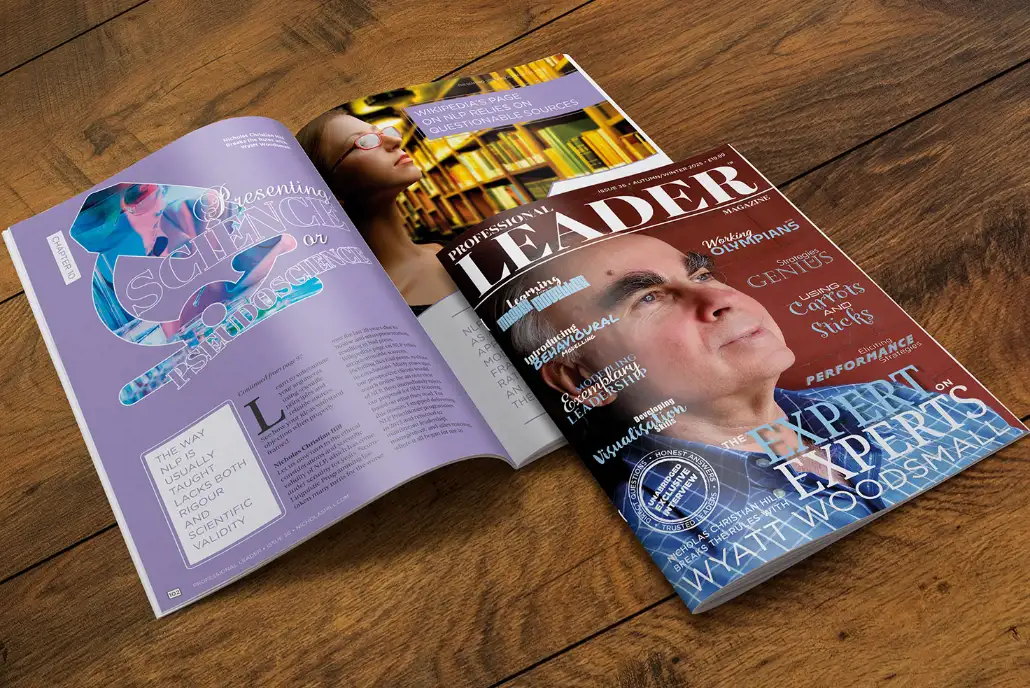
Presenting Science or Pseudoscience

Chapter Overview

Six Pages

Learn to substantiate your arguments using scientific principles and reliable sources. See how your ideas withstand objection when properly framed.

Nicholas Christian Hill

Let us now turn to the ethical considerations and scientific validity of NLP, which has come under scrutiny for years. Neuro-Linguistic Programming has taken many turns for the worse over the last 20 years due to misuse and misrepresentation, resulting in bad press. Wikipedia’s page on NLP relies on questionable sources, including this bad press, to draw its conclusions. Many years ago, our prospective clients would search online for an overview of NLP, then immediately reject our proposal for NLP training based on what they read. For this reason, I stopped delivering NLP Practitioner programmes in 2012 and returned to mainstream leadership, management, and sales training, where it all began for me in 1996. You have also felt the impact of this misrepresentation. In a recent article, you wrote, ‘The way NLP is usually taught lacks both rigour and scientific validity. Tragically, the way that some teach it is little removed from voodoo and witchcraft...which gives NLP a bad reputation.’ Please explain why you believe this happened to the industry.

Wyatt Woodsmall

That is an excellent question. To see the bad reputation of NLP, all you have to do is read the Wikipedia article, which is a total distortion of what NLP is about. Wikipedia is heavily influenced by contributors aligned with organisations such as the Committee for Skeptical Inquiry and dismisses anything it considers pseudoscience, including material in the social sciences. NLP has developed a bad reputation for two reasons. Firstly, it has not been presented as a science. The original creators of NLP were anti-intellectual. They claimed that it made no difference how it worked. You just needed to know that it did, and to focus on that, whereas the world wants to know why it works. The world wants things to be scientific.

Nicholas Christian Hill

This is what I have found, too, and it used to disappoint me, especially in light of how practical and insightful many NLP models are for people who use them responsibly. NLP is often labelled a pseudoscience, particularly in public sources such as Wikipedia. That misjudgment typically confuses poor teaching and exaggerated claims with the methodology itself. NLP began as an applied modelling framework rather than an academic theory and has therefore been assessed using criteria that favour laboratory testing over results. Ironically, many of its core ideas now align with established research in neuroscience and cognitive psychology. The issue is the failure to present NLP in a scientific context, which has allowed critics to discredit it unfairly. While the industry has suffered long-term reputational damage, how do you suppose we learn from this experience?

Wyatt Woodsmall

In your trainer’s training, we discussed the 4MAT Model. In the ‘what’ quadrant, we talked about the importance of sharing the concept, principles, process, and procedure. The concepts and principles explain why it works and why it is scientific. NLP has a bad reputation because much of the unofficial material is New Age thinking, has all sorts of Green aphorisms, and is not based on any science. However, NLP research is grounded in science, yet many people are unaware of this and do not present it as such. So, the world looks at it and says, ‘This is not something we are interested in. This is not scientific.’

Nicholas Christian Hill

We trainers and expert teachers alike use the 4MAT Model, developed by Dr Bernice McCarthy, to guide learners through a four-part cycle, each represented by quadrants or ‘mats’, hence the name. Quadrant 1, covered earlier, is the ‘why’. Quadrant 2 is the ‘what’. Quadrant 3 is the ‘how’. Finally, quadrant 4 is the ‘what-if’. Suppose a manager is teaching or training their team. Before turning attention to the ‘how,’ they must take their audience through the ‘what’. If they fail to substantiate their argument with evidence and scientific principles, their team could be sceptical of any proposal. Wyatt, please share your findings on scientific validity, as you deliver trainers’ training around the globe.

Wyatt Woodsmall

I teach worldwide and have taught in 30 countries. Particularly in the Arab world, where I do a lot of training, everybody wants NLP to be scientific. They need to present it scientifically; otherwise, their society will not listen. Part of the problem is that the people who are teaching NLP are good, well-meaning, but they do not care about understanding its concepts and principles. They do not understand the science and have not taken the time to figure out why NLP works. NLP should be presented primarily as a science. You need to explain the principles and why they work.

Nicholas Christian Hill

We agree that NLP has historically been poorly presented. However, the irony is that modern neuroscience supports some NLP techniques that were established long before research explained why they work! The work of Michael Merzenich on neuroplasticity, later popularised by Norman Doidge, shows that repetition of thought, language, and behaviour can rewire neural pathways. This research aligns with NLP's long-standing emphasis on the importance of conditioning, rehearsal, and state management. Marc Jeannerod’s work and fMRI research on mental imagery and motor simulation demonstrate that imagining an action engages many of the same neural circuits as acting it out. This aligns with NLP’s long-standing use of visualisation and mental rehearsal. Likewise, Karl Friston’s research on predictive processing and perception shows how the brain actively constructs experience based on expectation and sensory input. This mirrors NLP’s assertion that people respond behaviourally to their internal representations. You said NLP has developed a bad reputation for two reasons. What is the other reason?

Wyatt Woodsmall

The second reason is that NLP has been accused of being unethical. And there is a reason. One well-formed condition for outcomes is that they must be ecological. Ecology is the study of consequences and the tracing of their effects through a system. However, ecology applies to systems; it applies to the outside of the collective. It does not apply to the inside of the individual, or to the inside of the collective. The inside of the collective is ethics. Ethics and ecology are two different concepts. One of the things I have done in my trainings is modify the well-formed conditions for outcomes to ensure they are both ethical and ecological. Ethics depends on the culture in which you operate. NLP, because it has ignored ethics and focused solely on ecology, has led people to say, ‘Well, you are unethical.’ People need to understand that they must focus on both, and the outcome conditions must be amended to ensure outcomes are both ethical and ecological. These are two primary reasons NLP is in a bad situation.

Nicholas Christian Hill

I recall you describing ethics and ecology in this same way years ago. Following my work with you, I continue to communicate to my clients the importance of both. To reinforce understanding, I use metaphors frequently in training. The metaphor I use for ethics and ecology might go something like this: imagine you are standing by a lake. You can see a mirrored reflection of all the surrounding landscape. Not a creature stirs under the water. You pick up a rock, and with a flick of your wrist, you skim it across the lake, creating ripples that eventually reach the other side. Now, let’s break down the metaphor. Your internal state and processes that motivated your actions are subject to ethical scrutiny, so you would need to ask yourself questions like ‘Why did I want to do that?’ or ‘What was the trigger that initiated my behaviour?’ On the other hand, the effect on the external environment would determine the ecology. Here, you would need to ask questions like, ‘How did my actions affect the lives of creatures in the lake and outside the lake?’ The metaphor then becomes a catalyst for discussing ethics and ecology in leadership. At that time, we get a shift of context.

Wyatt Woodsmall

That’s a good metaphor, Nicholas. One thing we need to understand is that ethics concerns the inner workings of the collective. You do not have ethics in isolation. Ethics is part of culture. It is not just what you think and believe. It is what people in the culture you operate in think and believe. It’s what they consider appropriate or inappropriate behaviour. What you think is always going to be shaped and influenced by the culture in which you are operating.

Nicholas Christian Hill

That is an excellent point. The metaphor I just shared presupposes that the person standing by the lake holds beliefs and values shaped by their culture, and that these are not arbitrary or self-initiated. It depends on which box you are standing in. You might be standing in the context of your home, your work, your community, your church, your synagogue, and so forth.

Wyatt Woodsmall

Correct. And you may be standing in multiple boxes!

Wyatt Woodsmall Interview Chapter 11

Conversation Focus

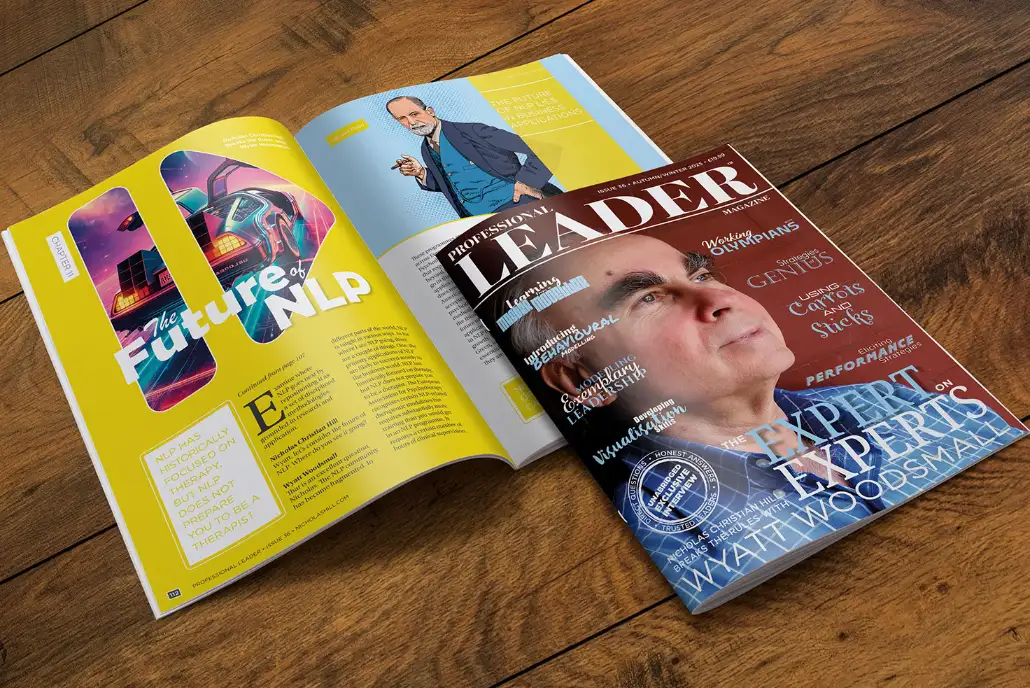
The Future of NLP

Chapter Overview

Six Pages

Examine where NLP goes next by repositioning it as a set of disciplined methodologies, grounded in research and application.

Nicholas Christian Hill

Wyatt, let’s consider the future of NLP. Where do you see it going?

Wyatt Woodsmall

That is an excellent question, Nicholas. The NLP community has become fragmented. In different parts of the world, NLP is taught in various ways. As for where I see NLP going, there are a couple of things. One: the primary applications of NLP are likely to succeed mostly in the business world. NLP has historically focused on therapy, but NLP does not prepare you to be a therapist. The European Association for Psychotherapy recognises certain NLP-related therapeutic modalities but requires substantially more training than you would get in an NLP programme. It requires a certain number of hours of clinical supervision. These programmes are set up across Europe and in the UK. Psychotherapy is a specialisation that requires additional training beyond NLP. A few people will go in that direction, but that applies only to Europe. That does not apply in America. In America, NLP will never be accepted as a legitimate form of psychotherapy because of the medical model that controls the thinking in the US. The future of NLP lies in business applications. Most of the people in NLP focus on personal growth. Many of the people are Green, and these people are essentially anti-intellectual. They are highly affiliative.

Nicholas Christian Hill

We are now discussing Spiral Dynamics. Let me jump in for our readers. Spiral Dynamics is a model based on the theory developed by psychologist Clare Graves. It uses the concept of ‘memes’ to describe value systems, or worldviews, if you will, that are shaped by culture and life conditions. Each meme is categorised into eight areas and named by colour for simplicity. Wyatt, you just referred to the ‘green’ meme, which concerns the human bond and is the Relativistic meme.

Wyatt Woodsmall

Yes. There is considerable Green NLP, particularly in Europe and England. Green NLP is frequently and unnecessarily corrective of problems raised by Blue and Orange NLP, but the future is Yellow and Turquoise in the Graves model. In any case, NLP needs to focus on business, and my wife Marilyne and I are trying to present that we need a Yellow version that does this. NLP is dying a death of gradual assimilation. When NLP is taught to businesspeople, they simply adopt parts of it. Now, when you go to teach it in the business world, they go, ‘We already know that.’ When you go, ‘Oh, are you trained in NLP?’ they go, ‘NLP? Never heard of it.’ NLP has been taught as a set of procedures that anyone can adopt and apply. The problem is that NLP has not been taught as a science, with supporting concepts, principles, or processes.

Nicholas Christian Hill

Please allow me to summarise the meanings of those other colours to which you have referred. ‘Blue’ is purposeful, whilst ‘Orange’ is strategic, so both conflict with the anti-intellectual ‘Green’. Wyatt, you refer to the future of NLP as ‘Yellow,’ which is systemic, and ‘Turquoise,’ which is holistic, both of which belong to the evolved second tier in the Graves model. Wyatt, you mentioned how many practitioners have reduced NLP to simply a set of procedures. Are you referring specifically to techniques?

Wyatt Woodsmall

Yes. Anybody can take over techniques. On one level, it is highly successful because people in the culture have adopted it and follow it. On another level, because they are not labelling it as NLP, the techniques are being assimilated without any understanding of the science behind them. Also, it happened because most early NLP Trainers were all Green, which is why NLP got a bad reputation in the business world to start with. They believed that business was bad and that money was the root of all evil. When they began teaching businesspeople, they thought they were converting them to their worldview. Businesspeople are not stupid, so they were offended by this. They decided, ‘We do not need this.’ Well, you need it if you are going to do NLP for business; you have to be able to do an Orange form of NLP that appreciates money and appreciates where businesspeople operate from, and that is adapted to that values system and that culture. You put a bunch of Green NLP Practitioners and a bunch of Orange NLP Practitioners in the same room, and immediately, a war develops. Green decides that Orange is unethical, and Orange decides that Green is totally naive and hopeless. It is a real mess.

Nicholas Christian Hill

Yes. It is a mess, yet it is also somewhat of a surprise, since NLP Master Practitioners must operate from an objective perspective, with respect for various psychological ‘maps’ of the world. This respect often matures into curiosity and necessitates investigating the probable causes that underpin the beliefs and values that drive the behaviour of those who operate from Green, Orange, or other paradigms. In fact, my answer to those quizzical clients is that their negative experience with NLP may have been due to malpractice by certain practitioners, rather than by trainers. I am surprised to find such clients asking me what the difference is between the two titles. I reply with ‘the trainer trains the practitioner,’ and we expect the former to have significantly more knowledge and experience. So, Wyatt, where is NLP going in all of this confusion?

Wyatt Woodsmall

NLP is going in several different directions. Which one will eventually win out? That is the problem, because one creates problems for the other. So if you do Orange NLP, then Green gets all upset and says, ‘This is an abuse of NLP, this is unethical, and we do not want this.’ Whereas Orange goes, ‘These people are touchy-feely, these people are airy-fairy, and if this is NLP, then we do not want anything to do with this, because these people are hopelessly naive.’ We see the same value conflicts we find in society, in NLP. Eventually, what will win out? We are not sure. Ken Wilber says if we can get another several per cent of the population from Green to move into Yellow, that will cross the threshold, and the movement will upscale everyone. It may be happening, but it is taking longer than I would like.

Nicholas Christian Hill

Sure. Neither of us can wait for Green to migrate to Orange or Yellow, so in the meantime, those who already operate in Orange or Yellow paradigms can integrate NLP frameworks with leadership and management models. You said that NLP is dying through assimilation. On the other hand, it may be the only way to sustain the lifeblood of these valuable models. Green could undo any good work carried out by Yellow NLP Practitioners anyway. Perhaps Yellow should build on what we know and start from where the world is today. This means we need to develop new methodologies based on the latest research. In the meantime, if we continue to share NLP models, then we must communicate the scientific principles and processes to validate claims and support the results we achieve.

Nicholas Christian Hill

Training providers must be creative when adopting NLP models in their training courses. Let me give you some examples of how our clients find it useful. NLP models, such as well-formed outcomes, are beneficial for goal setting, framing and reframing for change management, anchoring for emotional intelligence, rapport and positive communication for conflict management, chunking for negotiation, the feedback model and perceptual positions for performance management, the Milton Model and Meta Model for advanced communication skills, and modelling for leadership styles. We could list many more, could we not, Wyatt? What are your thoughts on this position?

Wyatt Woodsmall

Well, that is the direction I am going in. That is the direction I would like to see NLP go in. Unfortunately, there are too many of the personal growth people out there. There is nothing wrong with personal growth, but they believe their model is the only one. We need to recognise that there are different models of the world, as NLP discusses, but NLP does not necessarily respect or understand these models, nor does it know how to communicate with them. NLP is powerful in sales. It is powerful in negotiation. I modelled a man who was the top salesman in his industry’s history, selling half a billion dollars’ worth of product in five years. He came up with a high-end sales training, called the Rainmaker Seminar, which was based on what a super-salesman actually did, as opposed to all sales training that is based on somebody’s theory of what works. Once, a woman attended the training and returned within a week. She had closed a ten-million-dollar sale. We asked, ‘How did you do this?’ She said, ‘All I did was exactly what you told me.’

Nicholas Christian Hill

That is a perfect example of the many claims from Green NLP Practitioners, who simply state that, ‘NLP works. Who cares about scientific validity?’ Before we close our discussion, earlier on, we mentioned Wikipedia’s article on NLP. I find it extraordinary that Wikipedia dismisses NLP as a pseudoscience, yet it hosts well-referenced articles on many NLP models. Topics such as chunking, rapport, representational systems, modelling, framing, and reframing, to name just a few, appear in Wikipedia without any reference to pseudoscience. This seems to be a contradiction. However, labelling NLP as a pseudoscience should not prevent further scientific investigation by those operating from Orange or Yellow into the millions of claims made in its favour. Furthermore, we now have 40 years of historical documents from thousands of NLP Practitioners, whether Green or Yellow, testifying to the efficacy of NLP tools, regardless of whether the trainer uses scientific principles to substantiate their claims. In light of this, I choose to refer to NLP as an ideology rather than a science, given the subjective nature of experience when using NLP tools. Frankly, we would not have this problem if we had never referred to NLP as a science in the first place. As you have indicated, Wyatt, those people operating inside Green models of the world will not care about this evident industry dilemma anyway.  

Wyatt Woodsmall Interview Chapter 12

Conversation Focus

Strategies of Genius

Chapter Overview

Six Pages

Learn the strategies used by Walt Disney to dream big, plan realistically, and think critically by considering all factors before taking action.

Nicholas Christian Hill

To conclude our discussion today, I would like to turn our attention to Robert Dilts’ excellent work, Strategies of Genius Volume I and Volume II, which sit on my shelf behind me. Dilts modelled the thinking strategies of historical geniuses including Aristotle, Albert Einstein, Walt Disney, Wolfgang Amadeus Mozart, and Sir Arthur Conan Doyle's Sherlock Holmes. Dilts highlighted Aristotle’s ability to categorise experience, define first principles, and move systematically from observation to abstraction. Dilts showed that Doyle’s creativity rested on disciplined observation, the elimination of assumptions, and the ability to move from sensory detail to logical conclusion. Dilts found that Mozart composed by hearing complete musical structures internally, then refining them through iterative variation.

If I may, I will now share his study on Disney. Dilts uses the coded strategies we have been discussing today. Also, what’s clear from these books is that, because Dilts is modelling other people, he is applying Outside Modelling, as you do, Wyatt. However, because the subjects are deceased, he can only deconstruct what they did through Modelling 1. To undertake Modelling 2, he must infer how they did it from their published material. Using Disney’s tendency to adopt the roles of the Dreamer, Realist, or Critic in board meetings, Dilts determined the following strategies, which I will break down as follows:

VAK
These references point to the three primary sensory modalities for coding and interpreting experience:

  • V (Visual): includes images, colour, shape, movement, spatial relationships
  • A (Auditory): includes sounds, words, tone, rhythm
  • K (Kinaesthetic): includes physical sensations, balance, movement, bodily feeling

C/E/a/d/Ad

These references clarify whether experience is constructed internally or perceived externally, whether it is associated or dissociated, and whether it involves internal dialogue:

  • C = Constructed: internally generated experience (imagining, visualising, creating, simulating)
  • E = External: externally perceived experience (seen, heard, or felt in real time)
  • a = Associated: experiencing an event from within one's own perspective
  • d = Dissociated: experiencing an event from an observer or third-person perspective
  • Ad = Auditory Digital: internally generated dialogue, such as self-talk

Dreamer Strategy (Generating Possibility)
  1. Auditory External (AE): Receive multiple sound sources to generate ideas, such as music and dialogue
  2. Visual Construct (VC): Create multiple related mental images from the externally generated sound sources
  3. Visual Construct (VC to VC): Become immersed in the mental imagery with a future orientation, imagining ideal scenarios
  4. Kinaesthetic (K): Become physically involved in the experience by feeling the related movement, pacing, energy, and emotion
  5. Visual External (VE): Physically sketch out the imagined scenes on paper
Realist Strategy (Being Realistic)
  1. Visual Construct (VC): Imagine the vision as if it is fully realised
  2. Kinaesthetic Association (K): Fully associate into the people in the vision and perform the actions as if you are experiencing the realised dream
  3. Visual Construct Repeated (VC to VC): Chunk the realised but imagined vision into sequential steps
  4. Visual Construct + Kinaesthetic (VC to K): Future-pace each chunked step by mentally rehearsing each one
  5. Visual External (VE): Create physical visuals such as sketches or storyboards based on the updated realistic vision
Critic Strategy (Identifying Blind Spots)
  1. Visual Construct Dissociation (VCd): Dissociate from the vision to create emotional and cognitive distance, and adopt a third position
  2. Auditory Digital (Ad): Employ critical thinking to apply rules and criteria to the vision
  3. Visual Construct (VC): Run the vision through multiple hypothetical scenarios to test ethics and ecology
  4. Visual Construct + Auditory Digital (VC to Ad): Perform a contrast analysis using a present-state-desired-state comparison to identify weaknesses or risks
  5. Auditory External + Visual External (AE + VE): Invite corrective feedback on the visuals to identify and address blind spots
Source: Nicholas Christian Hill, Professional Leader Magazine, Issue 11, Spring/Summer 2013, The Walt Disney Lessons

Wyatt, in closing, you have been involved in NLP for over 40 years, so I have a cheeky question. Do you ever plan to retire? If so, how would you spend your time?

Wyatt Woodsmall

Okay. At this point, I do not plan to retire because I enjoy my work. I enjoy modelling, capturing excellence, and figuring out how people do what they do, like a detective with a puzzle. I enjoy travelling around the world. As I have said, I have delivered training worldwide, which has given me insight into different cultures and ways of understanding. There are some things I would like to do and some places I would like to go. I need to integrate that with ongoing modelling.

Nicholas Christian Hill

Dr Wyatt Woodsmall, it has been an absolute pleasure to speak with you again today. We wish you the very best in your endeavours in the coming years. I would like to conclude our discussion with sincere gratitude for taking the time today to share your ideas with us, and for your mentorship during my trainer training in 2006.

Wyatt Woodsmall

Thank you, Nicholas. You have come a long way since I first worked with you, and you are doing a fabulous job.

Further Reading from Nicholas Christian Hill

Further Reading from Dr Wyatt Woodsmall

Scroll to Top